
Managing IT equipment does not end when a device is purchased or deployed. Organizations need a clear strategy for tracking assets throughout their lifecycle and responsibly handling them when they reach the end of their useful life. This is where ITAM (IT Asset Management) and ITAD (IT Asset Disposition) come in.
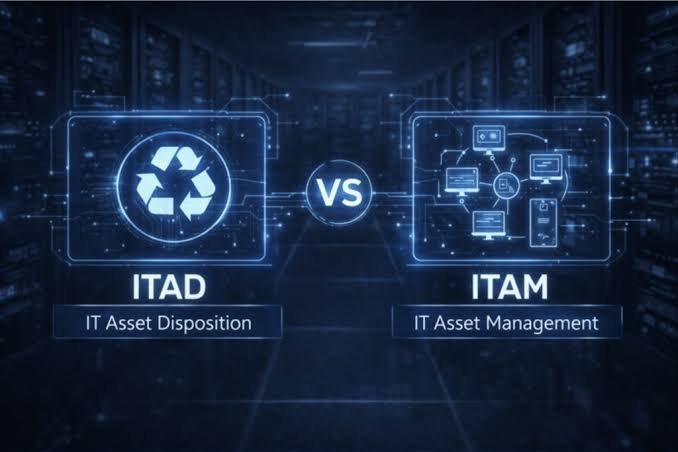
Two important concepts in IT asset management are ITAM (IT Asset Management) and ITAD (IT Asset Disposition). Although they are closely connected, they serve different purposes.
Understanding the difference can help organizations manage technology more efficiently, reduce risks, protect data, and dispose of equipment responsibly.
What Is ITAM?
IT Asset Management (ITAM) is the process of managing an organization’s IT assets throughout their entire lifecycle.
ITAM typically covers everything from purchasing and deployment to maintenance, upgrades, and eventual retirement.
An ITAM program may track:
- Laptops and desktop computers
- Servers and storage equipment
- Smartphones and tablets
- Network equipment
- Software and licenses
- Monitors and peripherals
- Data center equipment
The goal is to know what IT assets an organization owns, where they are, who is using them, their condition, and what happens to them throughout their lifecycle.
Why Is ITAM Important?
Effective ITAM helps organizations:
- Reduce unnecessary IT spending
- Track assets accurately
- Improve equipment utilization
- Plan replacements and upgrades
- Maintain accurate asset records
- Support compliance and audits
- Identify security risks
In simple terms, ITAM manages IT assets while they are part of the organization’s technology environment.
What Is ITAD?
IT Asset Disposition (ITAD) focuses on what happens to IT equipment when an organization no longer needs it.
ITAD is the structured process of retiring, handling, securing, and disposing of end-of-life or surplus IT assets.
A professional ITAD process may include:
- Asset identification and inventory
- Secure collection and transportation
- Data sanitization or destruction
- Evaluation and appropriate disposition
- Reuse, refurbishment, recycling, or destruction
- Documentation and reporting
- Certificates of data destruction or recycling where applicable
The objective is to ensure that retired equipment does not create unnecessary data security, environmental, financial, or compliance risks.
ITAD vs ITAM: The Key Difference
The easiest way to understand the difference is to look at their scope.
| ITAM | ITAD |
|---|---|
| Manages IT assets throughout their lifecycle | Focuses on assets being retired or disposed of |
| Starts with acquisition and deployment | Usually begins when equipment reaches end of use |
| Tracks ownership, location, condition and utilization | Manages secure retirement and final disposition |
| Helps optimize IT investments | Helps reduce risks associated with retired equipment |
| Covers the broader asset lifecycle | Covers the end-of-life or disposition stage |
ITAM is the broader lifecycle management process, while ITAD is a specialized part of the asset lifecycle focused on retirement and disposition.
How ITAM and ITAD Work Together
ITAM and ITAD should not be treated as competing processes. They work together.
For example, an organization may use its ITAM system to identify laptops that are approaching the end of their useful life.
Once those laptops are approved for retirement, the ITAD process can take over.
The devices can then be:
Identified → Collected → Data Sanitized → Evaluated → Reused/Recycled → Documented
This creates a controlled transition from active IT asset management to secure asset disposition.
Why Data Security Matters in ITAD
Retired devices can still contain sensitive information even after they are no longer being used.
Laptops, hard drives, SSDs, servers, phones, and other storage devices may contain:
- Customer information
- Employee records
- Business documents
- Passwords and credentials
- Financial information
- Intellectual property
Simply deleting files or performing a factory reset may not always provide the level of assurance an organization requires.
A proper ITAD program should therefore include an appropriate data sanitization or destruction process, supported by documentation where required.
What Happens to IT Assets After ITAD?
The final destination depends on the condition, age, security requirements, and organizational policies surrounding the equipment.
Possible outcomes include:
Reuse
Functional equipment may be redeployed within the organization.
Refurbishment
Some equipment can be repaired or upgraded for further use.
Recycling
Equipment that has reached the end of its useful life can be processed through responsible electronics recycling.
Secure Destruction
Equipment or storage media that cannot be safely reused may require controlled destruction.
The important principle is that disposition should be based on a documented and responsible decision rather than simply throwing equipment away.
How to Build a Better IT Asset Lifecycle
Organizations can connect ITAM and ITAD by establishing a clear lifecycle:
1. Plan
Determine technology requirements and asset standards.
2. Acquire
Purchase and record IT equipment.
3. Deploy
Assign assets to employees, departments, or locations.
4. Manage
Track usage, maintenance, repairs, and changes.
5. Retire
Identify assets that are obsolete, damaged, or no longer required.
6. Dispose
Use an appropriate ITAD process for secure data handling and final disposition.
7. Document
Maintain records of the asset’s final outcome.
This approach provides greater visibility from the moment an asset enters the organization until it reaches the end of its lifecycle.
Final Thoughts
ITAM and ITAD are different, but they are closely connected.
ITAM provides visibility and control over IT assets throughout their lifecycle, while ITAD manages the secure and responsible retirement of those assets.
A strong IT asset strategy should consider both. By connecting asset management with secure disposition, organizations can protect data, improve asset utilization, reduce waste, support compliance, and make better technology decisions.
Whether an organization is retiring a few laptops or decommissioning an entire data center, a structured approach to ITAM and ITAD can make the process safer, more efficient, and more sustainable.