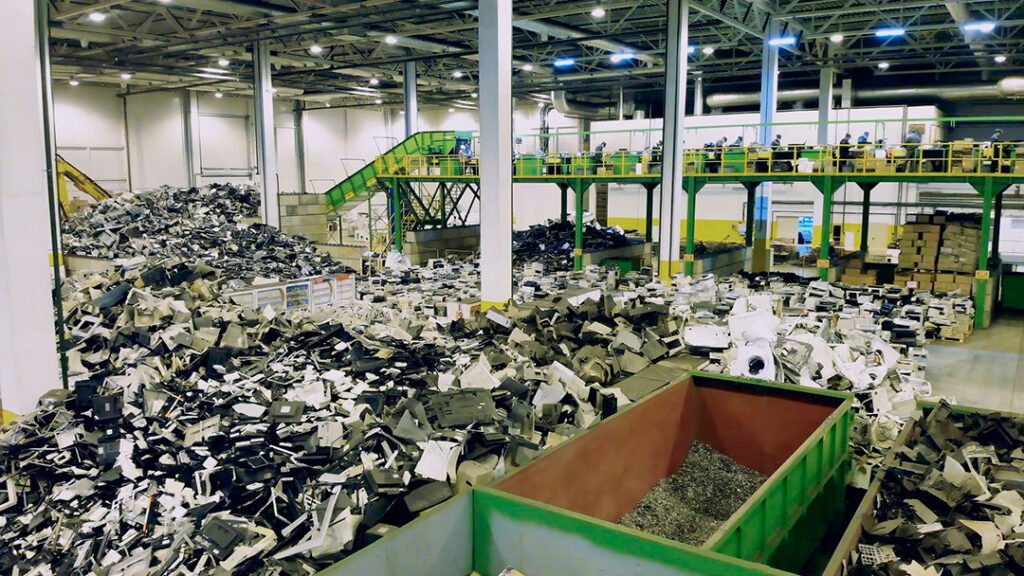
When we think about mining, we often imagine workers extracting minerals from the ground. But there is another source of valuable materials all around us: discarded electronic devices.
Urban mining is the process of recovering valuable materials from discarded products, infrastructure and waste instead of relying only on newly extracted natural resources. In e-waste recycling, it involves recovering materials such as copper, aluminium, steel and precious metals from old electronics. As electronic waste continues to grow worldwide, urban mining is becoming an important part of resource recovery and the circular economy.nt.
As the world produces more electronic waste, urban mining is becoming an important part of the circular economy.
What Is Urban Mining?
Urban mining is the recovery of valuable materials from discarded products, buildings, infrastructure and waste streams. In e-waste recycling, it involves recovering metals, plastics and other materials from unwanted electronic equipment for recycling and potential reuse.
Think of a city’s landfills, junkyards, and storage rooms as a giant, artificial ore deposit. Instead of blasting through rock in a remote mountain, “miners” extract gold, copper, silver, and rare earth elements from circuit boards, cables, and appliances sitting right in our neighborhoods.
In e-waste management, urban mining involves collecting unwanted electronics and processing them to recover materials such as:
Precious metals — gold, silver, and platinum from circuit boards and connectors
Base and industrial metals — copper, aluminum, and steel from wiring, casings, and appliances
Critical and rare earth elements — cobalt, lithium, and neodymium from batteries and magnets, increasingly important for EVs and renewable energy
How the Process of Urban Mining Actually Works
Recovering usable material from waste isn’t as simple as melting things down. It generally follows a few stages:
1. Collection
Gathering discarded devices, vehicles, or materials through take-back programs, recycling centers, or demolition sites.
2. Sorting
Equipment is sorted according to its type, condition and material composition. Devices may include computers, phones, printers, servers, cables, monitors and other electronic equipment.
3. Dismantling
Electronics are carefully dismantled so that different components and materials can be separated.
For data-bearing equipment, secure data destruction or sanitization should take place before equipment is recycled or processed, particularly when devices have been used by businesses or organizations.
4. Processing
using mechanical shredding, chemical treatment, or smelting to separate metals from plastics and other materials.
5. Refining
purifying the recovered metals to a quality that manufacturers can reuse.
6. Reintegration
feeding the recovered materials back into supply chains to make new products.
Why Is Urban Mining Important?
It Reduces Pressure on Natural Resources
Traditional mining requires the extraction of minerals from the earth. Recovering materials from existing products can provide an additional source of raw materials.
It Supports the Circular Economy
Urban mining helps keep materials in circulation rather than allowing them to become waste. This supports the principle of using resources for longer and recovering materials at the end of a product’s useful life.
It Helps Reduce E-Waste
Electronic waste is one of the world’s fastest-growing waste streams. Responsible recovery can prevent valuable materials from being lost through uncontrolled disposal.
It Can Recover Valuable Metals
Some electronic components contain concentrations of metals that make material recovery worthwhile. Printed circuit boards, for example, can contain copper and smaller quantities of precious metals.
It Creates Economic Opportunities
Urban mining can support businesses and jobs in collection, logistics, dismantling, recycling, material recovery and environmental services.
It strengthens supply chains for critical minerals, which are in high demand for batteries, solar panels, and electric vehicles — and which many countries currently have to import.
Urban Mining vs Traditional Mining
The two approaches are different, but they can complement each other.
| Traditional Mining | Urban Mining |
|---|---|
| Extracts materials from the earth | Recovers materials from existing products and waste |
| Requires mining and processing of natural deposits | Uses materials already present in the economy |
| Depends on geological resources | Depends on discarded products and infrastructure |
| Produces mining-related waste | Helps recover materials from waste streams |
| Supplies new raw materials | Helps return existing materials to production |
Urban mining does not completely replace traditional mining. Instead, it provides another way to obtain and reuse valuable resources.
Why It Matters Beyond the Money
Urban mining isn’t just a clever way to make cash from junk. It solves several problems at once:
- It reduces the need for traditional mining, which is often environmentally destructive and energy-intensive.
- It cuts down on toxic waste, since e-waste contains hazardous substances like lead and mercury that can leach into soil and water if dumped improperly.
- It supports the circular economy, keeping materials in use longer instead of extracting new ones and discarding old ones in a straight line from factory to landfill.
- It strengthens supply chains for critical minerals, which are in high demand for batteries, solar panels, and electric vehicles — and which many countries currently have to import.
The Challenges
Urban mining isn’t a silver bullet. A few real obstacles stand in the way:
- Collection is inconsistent. Many countries lack accessible drop-off points or formal recycling systems, so waste ends up in general trash or informal scrapyards.
- Informal recycling can be dangerous. In parts of the world, e-waste is broken down by hand without protective equipment, exposing workers to toxic chemicals.
- Processing is technically demanding. Separating tiny amounts of valuable metal from complex, mixed materials requires specialized (and sometimes expensive) technology.
- Public awareness is low. Many people don’t realize their old electronics have real value, so devices sit unused instead of being recycled.
What You Can Actually Do
Urban mining works at a global, industrial scale — but it starts with everyday choices:
- Don’t toss old electronics in regular trash. Look for certified e-waste recycling programs or manufacturer take-back schemes.
- Sell or donate working devices instead of letting them gather dust; extending a product’s life is the simplest form of urban mining.
- Support brands and retailers that use recycled materials or offer trade-in and repair programs.
- Advocate locally for better e-waste collection infrastructure if your area doesn’t have one yet
The Bottom Line
Urban mining is essentially about finding value in what has already been produced.
Old electronics may contain materials that can be recovered and returned to productive use. By combining responsible e-waste collection, secure data destruction, recycling and material recovery, organizations can help reduce waste while contributing to a more circular economy.
The next time you see an old computer, phone, server or cable, remember: it may not simply be waste—it may also be a source of recoverable resources.
Nalabix Eco supports responsible e-waste recycling and secure data destruction, helping organizations manage end-of-life electronics responsibly and recover materials through appropriate recycling channels.