
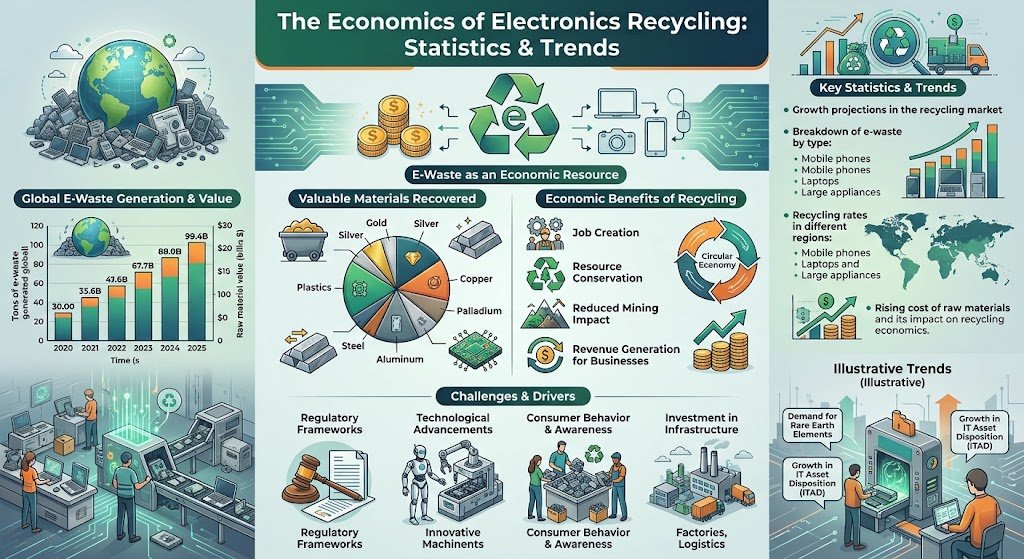
Electronics recycling is often discussed as an environmental issue, but it is also an economic one.
Computers, smartphones, servers, appliances, televisions and other electronic products contain metals, plastics, glass and other materials that can potentially be recovered and returned to productive use. At the same time, collecting, transporting, dismantling and safely processing these products requires infrastructure, labour, technology and investment.
This creates an important economic question:
How much value is contained in discarded electronics, and how much of that value is actually recovered?
Global data shows that the opportunity is significant, but so are the costs of managing e-waste responsibly.
The Global E-Waste Economy in Numbers
The Global E-waste Monitor 2024, published by the International Telecommunication Union (ITU) and UNITAR, reported that the world generated 62 billion kilograms of e-waste in 2022.
That was equivalent to approximately 7.8 kg of e-waste per person.
Only 13.8 billion kg, or 22.3%, was documented as formally collected and recycled. This means that the majority of global e-waste was not documented as being managed through formal collection and recycling systems.
The economic significance becomes clearer when the materials contained in this waste stream are examined.
Billions of Dollars in Materials
E-waste is not made up only of waste materials. It contains resources that were originally extracted, processed and manufactured into electronic products.
In 2022, the metals contained in global e-waste had an estimated value of approximately US$91 billion.
This included approximately:
- US$19 billion of copper
- US$16 billion of iron
- US$15 billion of gold
The same e-waste stream contained an estimated 31 billion kg of metals, alongside approximately 17 billion kg of plastics and 14 billion kg of other materials, including glass, minerals and composite materials.
These figures describe the estimated value of materials contained in e-waste. They should not be interpreted as the amount that a recycler can earn from collecting discarded electronics.
Recovering those materials requires collection, sorting, dismantling, processing and access to appropriate downstream recycling markets.
Why E-Waste Has Economic Value
The economic value of electronics recycling comes mainly from resource recovery.
A discarded electronic product may contain several material streams. Depending on the equipment, these can include ferrous metals, non-ferrous metals, precious metals, plastics, glass and other materials.
Recycling allows some of these materials to be recovered and potentially used as secondary raw materials.
This reduces the need to obtain every material exclusively from new extraction.
The concept is often described as urban mining: recovering useful resources from products, infrastructure and waste already present in society.
According to the Global E-waste Monitor, documented e-waste recycling in 2022 recovered approximately US$28 billion worth of secondary raw materials.
That figure is considerably lower than the estimated US$91 billion value of metals contained in the year’s e-waste, illustrating the large gap between resources contained in electronic waste and resources actually recovered.
Recycling Is Not Free
One common misconception is that the value of metals automatically makes electronics recycling profitable.
In reality, recycling has substantial costs.
Electronic equipment must first be collected and transported. It may then need to be sorted, tested, dismantled and processed. Hazardous components may require controlled handling, while recovered materials need suitable downstream markets.
The economic model therefore depends on several factors, including:
- The type and quantity of equipment
- Material composition
- Collection and transportation costs
- Labour costs
- Processing technology
- Environmental and safety requirements
- Commodity prices
- The quality of recovered materials
- Availability of reliable downstream recycling facilities
A device containing valuable materials does not necessarily mean that recycling that individual device will generate a profit.
The economics are determined by the entire recycling chain.
The Hidden Cost of Poor E-Waste Management
The economics of e-waste extend beyond the price of recovered materials.
Improper handling can create environmental and social costs that are not always reflected in the market price of electronic products.
The Global E-waste Monitor estimated that the overall economic impact of global e-waste management in 2022 represented a net cost of approximately US$37 billion.
The assessment included approximately US$78 billion in externalized costs associated with impacts on people and the environment, including lead and mercury emissions, plastic leakage and contributions to global warming. It also estimated around US$10 billion in treatment costs.
Against these costs, the report identified approximately US$28 billion in recovered metals and US$23 billion in monetized value from avoided greenhouse-gas emissions as economic benefits.
This demonstrates an important point:
The economics of electronics recycling cannot be measured only by the resale value of recovered materials.
The costs avoided through proper management also matter.
E-Waste Generation Is Growing Faster Than Recycling
One of the most important trends is the widening gap between e-waste generation and formal recycling.
Between 2010 and 2022, global e-waste generation increased from approximately 34 billion kg to 62 billion kg.
During the same period, documented formal collection and recycling increased from approximately 8 billion kg to 13.8 billion kg.
The Global E-waste Monitor describes e-waste generation as growing almost five times faster than documented formal collection and recycling during this period.
This creates both an environmental challenge and an economic opportunity.
More electronic products reaching end of life means more material potentially available for recovery. However, without adequate collection and processing infrastructure, much of that value remains outside formal recycling systems.
The 2030 Outlook
The trend is expected to continue.
The Global E-waste Monitor projects that global e-waste generation could reach approximately 82 billion kg by 2030.
Under a business-as-usual scenario, the documented formal collection and recycling rate could fall from 22.3% in 2022 to around 20% in 2030, because e-waste generation is increasing faster than recycling capacity.
This is significant for the recycling industry.
If collection and recycling systems do not expand alongside electronic consumption, the quantity of potentially recoverable materials outside formal systems will continue to grow.
The Economic Importance of Secondary Raw Materials
One of the strongest economic arguments for electronics recycling is the production of secondary raw materials.
When metals are recovered from discarded electronics, they can become inputs for other manufacturing processes.
This does not eliminate the need for mining, but it can reduce dependence on virgin material extraction for some applications.
The Global E-waste Monitor estimates that documented e-waste recycling in 2022 avoided approximately 900 million tonnes of primary ore extraction.
This illustrates why e-waste recycling is increasingly connected to discussions about resource security, supply chains and the circular economy.
Electronics Recycling and Jobs
The economic impact is also broader than material recovery.
A functioning electronics recycling system requires people and businesses to perform activities such as:
- Collection and logistics
- Equipment sorting
- Repair and refurbishment
- Data destruction
- Dismantling
- Material separation
- Recycling
- Environmental compliance
- Equipment processing
- Secondary-material trading
This means e-waste management can support economic activity across multiple stages of the value chain.
However, the scale and quality of employment depend heavily on how formalized, regulated and technologically developed the recycling sector is.
Why Businesses Are Part of the Economic Equation
Businesses generate significant quantities of electronic equipment through normal technology replacement cycles.
When computers, servers, networking equipment, printers and other devices reach end of life, organisations must decide how those assets will be handled.
A responsible end-of-life programme can combine several activities:
Reuse and refurbishment where equipment remains suitable for further use.
Secure data destruction for devices containing sensitive information.
Material recovery for equipment that has reached the end of its useful life.
Documentation and certification to provide evidence of responsible handling.
This approach helps businesses look beyond disposal and consider the full value and risk associated with their electronic assets.
A Growing Circular Economy Opportunity
The economics of electronics recycling are closely connected to the circular economy.
A linear model largely follows:
Extract → Manufacture → Use → Dispose
A circular approach seeks to retain products, components and materials in productive use for as long as practical:
Manufacture → Use → Reuse → Repair → Recover → Recycle → Remanufacture
Not every electronic product can be reused or every material recovered economically. Nevertheless, improving collection and recovery can help retain more value within the economy.
The Global E-waste Monitor estimates that if global e-waste collection and recycling reached 60% by 2030, the resulting benefits could exceed the costs by more than US$38 billion.
The Future of Electronics Recycling
The future economics of electronics recycling will depend on whether countries, businesses and consumers can improve the way electronic products are collected, reused and recycled.
Important developments will include better product design, stronger collection systems, improved recycling technology, responsible refurbishment, effective data destruction, producer responsibility programmes and greater investment in recycling infrastructure.
As electronic consumption continues to grow, the question will no longer be simply “What should we do with old electronics?”
It will increasingly become:
“How much economic value can we recover from the electronics already in circulation?”
Final Thoughts
Electronics recycling is an economic activity built around resource recovery, risk management and circular supply chains.
The numbers are clear: billions of kilograms of e-waste are generated every year, billions of dollars’ worth of materials are contained within that waste, and a large proportion of those resources are not currently recovered through documented formal recycling.
The opportunity is therefore not simply to recycle more electronics.
It is to build systems that can collect more, recover more, reuse more and waste less.
As global e-waste generation moves toward an estimated 82 billion kg by 2030, the economic importance of responsible electronics recycling is likely to become even greater.