
Technology has transformed the way the world works, communicates, learns, travels, and does business. But behind every new smartphone, computer, television, appliance, server, and electronic device is another growing challenge: what happens when that equipment reaches the end of its useful life?
The answer is increasingly important because e-waste is the world’s fastest-growing waste stream.
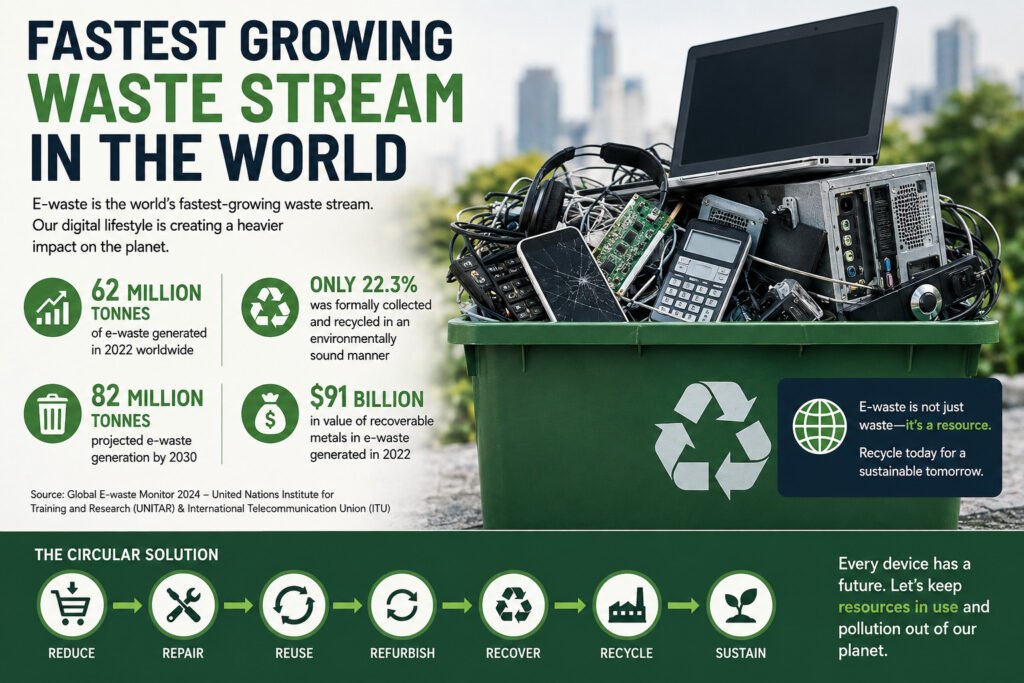
According to the Global E-waste Monitor 2024, the world generated approximately 62 million tonnes of electronic waste in 2022. Only 22.3% of that amount was documented as formally collected and recycled in an environmentally sound manner. Global e-waste generation is projected to reach approximately 82 million tonnes by 2030 if current trends continue.
The issue is therefore not simply about having more waste. It is about managing a rapidly growing stream of products that contain both valuable resources and materials requiring responsible handling.
What Is E-Waste?
E-waste, short for electronic waste, refers to discarded electrical and electronic equipment and its components.
It can include products that are broken, obsolete, unwanted, or simply no longer needed.
Common examples include:
- Computers and laptops
- Mobile phones and tablets
- Televisions and monitors
- Printers and photocopiers
- Servers and networking equipment
- Refrigerators and other appliances
- Cables, chargers, and accessories
- Audio and video equipment
- Electronic components and circuit boards
- Electrical and electronic equipment containing batteries
As technology becomes integrated into more areas of everyday life, the definition of e-waste continues to expand.
Why Is E-Waste Growing So Quickly?
The growth of e-waste is not caused by a single factor. It is the result of several changes happening at the same time.
1. Rapid Technological Innovation
Technology evolves quickly. New processors, operating systems, connectivity standards, features, and product generations are continuously introduced.
As newer technology becomes available, older equipment may become less useful, incompatible with modern systems, or too expensive to maintain.
This accelerates the replacement cycle.
2. More Electronics in Everyday Life
Electronics are now used across homes, offices, schools, hospitals, factories, transport systems, financial services, telecommunications, and government.
The world is becoming increasingly dependent on digital infrastructure.
More equipment in use eventually means more equipment reaching end of life.
3. Shorter Replacement Cycles
Many electronic products are replaced before they completely stop functioning.
Businesses may upgrade equipment because of performance, security, compatibility, or operational requirements. Consumers may replace devices because of new features or changing needs.
When replacement happens faster than repair, reuse, or refurbishment, the volume of discarded electronics increases.
4. Growing Digitalization
Cloud computing, smartphones, connected devices, automation, artificial intelligence, telecommunications, and digital services all depend on physical electronic infrastructure.
The expansion of the digital economy therefore has an environmental side effect: more electronic equipment eventually needs to be managed at the end of its useful life.
5. Limited Repair, Reuse and Refurbishment
A device that cannot be economically repaired or reused is more likely to become waste.
Limited access to spare parts, repair expertise, software support, and refurbishment markets can shorten the practical life of electronics.
The result is a growing gap between the amount of equipment being discarded and the amount being successfully kept in use.
How Much E-Waste Does the World Generate?
The scale of the problem is significant.
The Global E-waste Monitor 2024 reported that global e-waste generation increased from approximately 34 million tonnes in 2010 to 62 million tonnes in 2022. During the same period, documented formal collection and recycling increased from about 8 million tonnes to 13.8 million tonnes. However, e-waste generation grew much faster than formal recycling.
The report projects global e-waste generation to reach approximately 82 million tonnes by 2030 under current trends.
This growing gap between generation and formal recycling is one of the world’s biggest waste-management challenges.
E-Waste Is More Than Just Waste
One of the most important things about electronic waste is that it contains resources that can potentially be recovered.
The 2024 Global E-waste Monitor estimated that e-waste generated in 2022 contained around:
- 31 million tonnes of metals
- 17 million tonnes of plastics
- 14 million tonnes of other materials, including glass, minerals, and composite materials
The metals embedded in that e-waste were estimated to have a value of around US$91 billion.
These materials can include copper, aluminium, iron, and other valuable metals.
This is why responsible e-waste recycling is increasingly connected to the concept of urban mining—recovering useful materials from products that have already entered society rather than relying entirely on new extraction.
Why Is Improper E-Waste Disposal a Problem?
When electronic equipment is improperly dumped, burned, dismantled, or processed, it can create environmental and health risks.
Some electronic products contain hazardous substances or components that require controlled handling.
Improper management can contribute to:
- Soil contamination
- Water pollution
- Air pollution
- Unsafe working conditions
- Loss of recyclable materials
- Unnecessary resource extraction
- Increased pressure on waste-management systems
The problem is particularly serious where appropriate collection, recycling, treatment, and enforcement systems are limited.
The Global E-waste Monitor reported that formally documented collection and recycling in African countries was less than 1% in 2022, highlighting the need for stronger infrastructure and responsible e-waste management across the region.
The Hidden Cost of Lost Resources
Improper disposal does not only create pollution risks. It can also mean losing valuable materials that could have been recovered.
The Global E-waste Monitor estimated that approximately US$62 billion worth of recoverable natural resources was left unaccounted for through inadequate e-waste management in 2022.
Recycling electronics can therefore serve two purposes:
Reduce waste while recovering resources.
This makes e-waste management an important part of the transition toward a more circular economy.
What Is the Circular Economy for Electronics?
Traditional production often follows a linear model:
Take → Make → Use → Dispose
A circular approach aims to keep products, components, and materials useful for as long as possible:
Reduce → Repair → Reuse → Refurbish → Recover → Recycle
Instead of immediately treating an unwanted device as waste, its remaining value is considered first.
A suitable device may be reused or refurbished. Components may be recovered. Materials from equipment that has reached true end of life can be separated and recycled.
The goal is to reduce unnecessary waste while keeping valuable resources in circulation.
What Happens to Electronics at the End of Their Life?
Responsible end-of-life management can involve several stages.
1. Collection
Equipment is collected from households, businesses, institutions, or facilities through appropriate channels.
2. Assessment and Sorting
Items are assessed to determine whether they can be reused, refurbished, dismantled, or recycled.
3. Data Security
Data-bearing equipment requires special attention. Computers, servers, hard drives, SSDs, phones, and other storage devices may contain sensitive information.
Before equipment leaves an organization’s control, appropriate data sanitization or physical destruction should be considered based on the asset and security requirements.
4. Dismantling
Equipment is carefully separated into components and material streams.
5. Material Recovery
Metals, plastics, circuit boards, cables, and other recoverable materials are directed toward appropriate recycling processes.
6. Responsible Recycling and Disposal
Materials that can be recovered are recycled through suitable channels, while residual materials are managed responsibly.
This approach creates a controlled path from obsolete equipment to recovered resources.
Why Businesses Need to Take E-Waste Seriously
Businesses can generate significant amounts of e-waste when they upgrade IT equipment, replace office electronics, relocate facilities, or decommission data centers.
Without a structured disposal process, organizations may face several risks, including:
- Loss of sensitive information
- Poor asset tracking
- Environmental compliance concerns
- Uncontrolled disposal
- Loss of potentially recoverable materials
- Lack of documentation
A responsible corporate e-waste program should therefore consider the entire asset lifecycle—not simply the moment equipment is removed from an office.
For data-bearing equipment, secure data destruction and appropriate documentation can be particularly important.
What Can Individuals Do About E-Waste?
Consumers can also help reduce the growing e-waste problem.
Before disposing of an electronic device, consider whether it can be:
Repaired — Extend its useful life where practical.
Reused — Continue using it for another purpose.
Refurbished — Restore it for further use.
Donated — Where the equipment remains suitable and safe to use.
Recycled — Send equipment that has reached end of life through an appropriate recycling channel.
Personal data should also be securely removed from devices before they are transferred or recycled.
Most importantly, electronic equipment should not automatically be treated like ordinary household waste.
The Future of E-Waste Management
The amount of electronic equipment entering society is unlikely to decline as digital technologies continue to develop.
The challenge is therefore to ensure that waste-management systems grow alongside technology.
The future of responsible electronics management will increasingly depend on:
- Better collection systems
- Longer product lifecycles
- Repair and refurbishment
- Responsible product design
- Efficient recycling infrastructure
- Resource recovery
- Stronger policies and enforcement
- Better consumer awareness
- Responsible corporate asset management
The objective should not simply be to recycle more waste. It should be to prevent unnecessary waste, extend product lifetimes, recover valuable materials, and manage unavoidable waste responsibly.
Bottomline
The growth of e-waste is one of the clearest environmental consequences of our increasingly digital world.
In 2022 alone, the world generated 62 million tonnes of electronic waste, and global generation is projected to reach approximately 82 million tonnes by 2030 under current trends. At the same time, only a fraction of global e-waste is formally collected and recycled.
But e-waste is not simply a problem of disposal.
It is also a resource opportunity, a circular-economy challenge, an environmental responsibility, and—when data-bearing equipment is involved—a data-security issue.
The solution begins with changing the way we think about old electronics.
Instead of asking only, “How do we get rid of this device?”, we should ask:
“Can it be reused, repaired, refurbished, securely decommissioned, or recycled so that its remaining value is not lost?”
That shift—from disposal to responsible resource management—is essential for building a more sustainable electronics economy.