
Technology is advancing faster than ever. New smartphones, computers, appliances, electric devices, networking equipment, and connected technologies are entering our homes and workplaces every year.
But there is another side to this technological progress: what happens when these devices become obsolete?
Electronic waste, commonly known as e-waste, is already one of the world’s fastest-growing waste streams. According to the Global E-waste Monitor 2024, the world generated approximately 62 million tonnes of e-waste in 2022, while only 22.3% was documented as formally collected and recycled. The same report projects global e-waste generation to reach 82 million tonnes by 2030 if current trends continue.
These figures highlight an important question: What will the future of electronic waste look like?
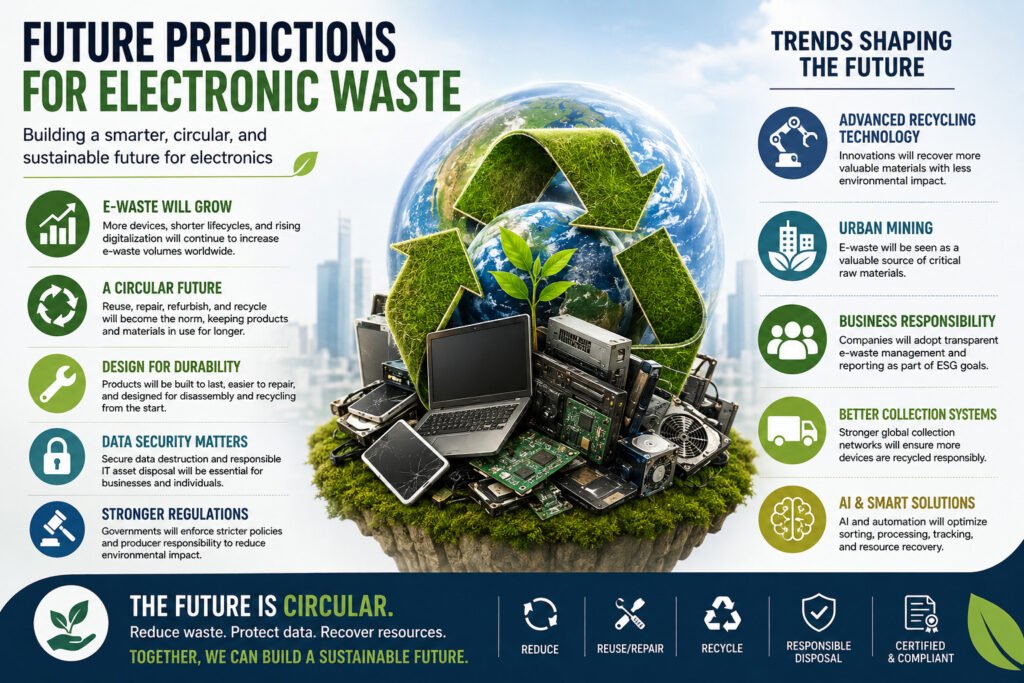
1. E-Waste Will Continue to Grow
The amount of electronic equipment in use worldwide is unlikely to decline.
Digital transformation, expanding internet access, connected devices, technological upgrades, and rising consumption are all contributing to greater demand for electronics. As more products reach the end of their useful lives, more e-waste will be generated.
The challenge is not simply producing more recycling capacity. It is building systems that can keep pace with the growth of electronic products from the moment they are manufactured to the moment they reach end of life.
2. The Electronics Industry Will Move Toward a Circular Economy
The traditional model of make, use, and discard is becoming increasingly difficult to sustain.
The future is likely to place greater emphasis on a circular electronics economy, where products and materials remain useful for as long as possible.
This means giving greater attention to:
- Repair
- Reuse
- Refurbishment
- Remanufacturing
- Component recovery
- Responsible recycling
Instead of treating an obsolete device as worthless waste, the circular economy looks at what can still be used, repaired, recovered, or recycled.
3. Longer Product Lifespans Will Matter More
One of the simplest ways to reduce e-waste is to keep electronic products in use for longer.
Future sustainability efforts are therefore likely to focus more strongly on product durability, repairability, software support, replacement parts, and maintenance.
A device that remains functional for several additional years does not immediately become another item requiring collection and recycling.
This makes extending product life an important part of future e-waste management.
4. Repair and Refurbishment Will Become More Important
Not every old electronic device needs to be recycled immediately.
Some equipment can be repaired, upgraded, refurbished, or reused. This can preserve the value already invested in the product and delay the need for new materials and manufacturing.
As businesses and consumers become more conscious of electronic waste, repair and refurbishment are likely to become increasingly important parts of the electronics lifecycle.
However, equipment that cannot be safely or economically reused should still enter an appropriate recycling or disposal process.
5. E-Waste Will Become an Increasingly Valuable Source of Materials
Electronic devices contain valuable materials, including metals and other recoverable resources.
The Global E-waste Monitor 2024 estimated that e-waste generated in 2022 contained approximately 31 million tonnes of metals, alongside significant quantities of plastics and other materials.
This creates an opportunity for urban mining—recovering useful materials from discarded products rather than relying entirely on newly extracted resources.
As demand for raw materials grows, responsible e-waste recycling could become increasingly important to resource security and the circular economy.
6. Recycling Technology Will Become More Advanced
The future of e-waste recycling will depend partly on better technology.
Improved sorting, dismantling, material separation, automated processing, and recovery technologies can help recyclers extract useful materials more efficiently.
Artificial intelligence, robotics, sensors, and data systems may also play a greater role in identifying equipment, improving sorting processes, tracking materials, and optimizing recycling operations.
Technology will therefore be both a driver of e-waste growth and an important part of the solution.
7. Data Security Will Become a Bigger Part of E-Waste Management
Electronic waste is not only an environmental issue.
Computers, servers, smartphones, hard drives, SSDs, and other storage devices may contain sensitive information long after an organization stops using them.
As businesses increasingly rely on digital information, secure data sanitization and physical data destruction will become even more important when equipment reaches end of life.
Future IT asset disposal programs will increasingly need to combine:
Asset management + data security + environmental responsibility.
Properly managing an old device should therefore involve both protecting the information stored on it and ensuring the equipment is handled responsibly.
8. Businesses Will Face Greater End-of-Life Responsibility
Organizations are likely to become more accountable for what happens to their electronic equipment after it leaves the workplace.
This is especially important for companies managing large quantities of:
- Computers and laptops
- Servers and networking equipment
- Printers and office electronics
- Storage devices
- Mobile devices
- Data-center equipment
Businesses will increasingly need documented processes for asset tracking, secure data destruction, responsible recycling, and environmental reporting.
E-waste management is therefore likely to become more closely connected with corporate sustainability, risk management, compliance, and governance.
9. E-Waste Regulations Will Continue to Develop
Governments are increasingly recognizing that e-waste requires dedicated policies, infrastructure, and enforcement.
The Global E-waste Monitor 2024 reported that 81 countries had an e-waste policy, legislation, or regulation in place in 2023, although enforcement and implementation remain significant challenges.
Future policies may place greater emphasis on areas such as:
- Extended producer responsibility
- Collection targets
- Recycling targets
- Product design
- Repairability
- Material recovery
- Responsible treatment of hazardous components
Regulatory requirements will vary between countries, but stronger accountability is likely to remain an important global trend.
10. Product Design Will Help Determine How Much E-Waste We Create
The future of e-waste begins before a product reaches the consumer.
Manufacturers can influence the eventual waste generated by designing products that are:
- More durable
- Easier to repair
- Easier to disassemble
- More efficient
- Less dependent on difficult-to-recover materials
- Designed with end-of-life recycling in mind
This approach is sometimes described as designing for circularity.
If products are designed with their entire lifecycle in mind, recycling and resource recovery can become easier at the end of their useful life.
11. Collection Infrastructure Will Need to Catch Up
A recycling system is only effective when discarded electronics can reach appropriate collection and processing facilities.
Many parts of the world still face challenges involving collection points, transportation, public awareness, recycling infrastructure, and access to formal e-waste management.
The future will therefore require stronger connections between consumers, businesses, manufacturers, retailers, governments, collection providers, and recyclers.
Better collection means more electronics can enter formal recycling systems instead of being stored indefinitely, discarded with general waste, or handled through environmentally unsafe methods.
12. Solar Panels and Other Emerging Electronics Will Add New Challenges
The future e-waste stream will not consist only of today’s computers and mobile phones.
As renewable energy, electric mobility, smart devices, and connected technologies expand, new categories of electronic products will eventually reach end of life.
For example, the Global E-waste Monitor 2024 projects retired photovoltaic panels to reach approximately 2.4 million tonnes in 2030, compared with around 600,000 tonnes in 2022.
This demonstrates why e-waste management must continuously adapt as technology changes.
What Could the Future of E-Waste Look Like?
The future could follow two very different paths.
The Linear Path
More devices → shorter lifespans → more discarded electronics → inadequate collection → resource loss and environmental risks.
The Circular Path
Better design → longer use → repair → reuse → refurbishment → secure end-of-life management → material recovery → recycled resources returning to production.
The second path offers a more sustainable model for managing the world’s growing dependence on technology.
The Biggest Opportunity: Treat E-Waste as a Resource
E-waste is often described as a waste problem, but it is also a resource opportunity.
Discarded electronics contain materials that can potentially be recovered and returned to productive use. The Global E-waste Monitor 2024 estimated that the metals contained in 2022 e-waste had a value of about US$91 billion.
Recovering these materials can reduce the need for some new extraction while creating economic opportunities around collection, refurbishment, recycling, and resource recovery.
The future challenge is therefore not simply to recycle more. It is to design a better system for keeping products, components, and materials in circulation.
Final Thoughts
Electronic waste will remain an important global environmental and resource challenge as technology continues to expand.
The answer will not come from recycling alone.
A more sustainable future will require a combination of longer-lasting products, better repair and reuse systems, responsible product design, stronger collection networks, secure IT asset disposal, advanced recycling technologies, effective regulation, and greater public awareness.
The future of electronics should not be defined by a simple cycle of buy, use, and throw away.
Instead, the goal should be a system where products are used longer, valuable components are recovered, sensitive data is securely managed, and materials are returned to the economy whenever possible.
The future of e-waste is not just about managing waste. It is about building a more circular relationship with technology.
Key Takeaway
As the world becomes more dependent on electronics, responsible e-waste management will become increasingly important. The organizations and communities that plan for the entire electronics lifecycle—from design and use to reuse, data security, recycling, and final recovery—will be better positioned for a more sustainable technological future.