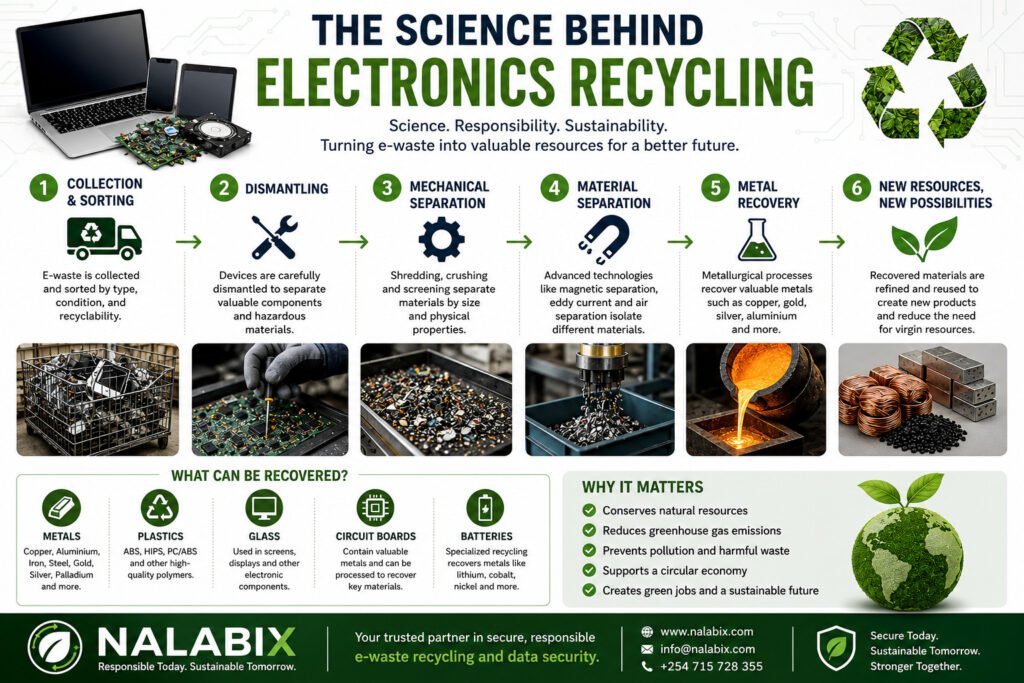
Inside electronic equipment is a complex mixture of metals, plastics, glass, circuit boards, and other materials. Some of these materials can be recovered and used again, while others require specialized handling.
Electronics recycling is the science of separating these materials and recovering them safely and efficiently.
What Is Inside Electronic Waste?
Electronic equipment is made from many different materials because each component has a specific technical purpose.
For example, cables are rich in copper, while circuit boards contain mixtures of metals, fiberglass and polymers. Screens and appliances have their own distinct material combinations.
How Does Electronics Recycling Work?
There is no single recycling process for every electronic device. However, responsible recycling commonly involves several connected stages.
1. Collection and Inspection
The process starts with collection and assessment.
Equipment is identified and sorted according to its type, condition, material composition, and potential for reuse or recycling.
Devices that still have useful life may be directed toward reuse or refurbishment. Equipment that has reached the end of its useful life moves into recycling and material recovery.
For businesses, this stage can also include identifying equipment that contains sensitive information.
2. Safe Removal of Batteries and Other Components
Certain components require special handling before further processing.
Batteries, for example, can present fire and safety risks if damaged or improperly processed. Other components may contain substances that require controlled treatment.
Removing these components early helps protect workers, equipment, and downstream recycling processes.
3. Dismantling and Demanufacturing
Next, electronic equipment can be dismantled into its major components.
A computer, for example, may be separated into:
- Circuit boards
- Cables
- Hard drives or SSDs
- Metal frames
- Plastic housings
- Power supplies
- Fans and other components
Dismantling makes it easier to direct different materials into the appropriate recovery streams.
It can also improve the recovery of valuable components compared with treating an entire device as one mixed material.
4. Size Reduction and Mechanical Processing
Some materials are further processed using shredding, crushing, milling, screening, or other mechanical techniques.
The objective is to liberate different materials from one another.
For example, a circuit board contains metals bonded with polymers and fiberglass. Mechanical processing can break the material into smaller fractions, making subsequent separation easier.
Research into printed circuit board recycling has demonstrated the use of crushing, screening, magnetic and electrostatic separation to concentrate metals and separate them from non-metallic materials.
5. Separating Metals Using Physics
One of the fascinating parts of electronics recycling is that different physical properties can be used to separate materials.
Magnetic Separation
Magnetic separators can remove ferrous metals such as iron and steel from mixed material streams.
Eddy-Current Separation
Eddy-current systems can separate certain non-ferrous metals, such as aluminium, from other materials.
Density and Air Separation
Materials with different densities or aerodynamic properties can be separated using specialized equipment.
Screening
Screens can separate processed materials according to particle size.
Together, these technologies allow recyclers to progressively separate complex mixtures into more concentrated material streams.
6. Recovering Metals From Circuit Boards
Printed circuit boards are among the most technically interesting components in e-waste recycling.
They contain a mixture of:
- Copper
- Tin
- Aluminium
- Iron
- Nickel
- Precious metals
- Fiberglass
- Polymers and other materials
After appropriate preprocessing, specialized metal recovery facilities can use different technologies to recover valuable metals.
Two broad approaches include pyrometallurgy and hydrometallurgy.
Pyrometallurgy
Pyrometallurgical processes use controlled high temperatures to process material and recover metals through melting, smelting, and refining.
Hydrometallurgy
Hydrometallurgical processes use controlled chemical solutions to dissolve and separate particular metals from processed materials.
These technologies require specialized facilities and environmental controls. They are not processes that should be attempted through informal or uncontrolled recycling.
7. What Happens to Recovered Metals?
Once metals have been separated and sufficiently processed, they can become secondary raw materials.
Recovered materials such as:
- Copper
- Aluminium
- Iron
- Steel
can potentially re-enter manufacturing supply chains.
Precious metals such as gold, silver, and palladium can also be recovered from appropriate electronic waste streams.
The value of this recovery is not only financial. Using secondary materials can help reduce the need to extract and process additional virgin resources.
8. What Happens to Electronic Plastics?
Plastics are another major part of the e-waste stream.
The recycling process may involve identifying, sorting, cleaning, grinding, and processing plastics according to their properties.
However, electronic plastics are not always straightforward to recycle.
Different polymers, additives, flame retardants, contamination, and mixed materials can make some plastics more difficult to recover economically.
Therefore, responsible recycling does not mean that every component will automatically become a new product. The objective is to maximize safe and technically viable recovery.
9. Glass and Other Materials
Electronic equipment can also contain substantial quantities of glass and composite materials.
Screens, for example, require specialized handling depending on their technology and composition.
Some materials can be recovered into appropriate processing streams, while materials that cannot be economically or safely recycled may require controlled treatment or disposal.
This is one reason why electronics should not simply be placed into ordinary household recycling systems unless the local program specifically accepts them.
The Chemistry Behind E-Waste Recycling
Chemistry becomes particularly important when physical separation alone cannot produce sufficiently pure materials.
Chemical processes can help:
- Dissolve selected metals
- Separate metals from other materials
- Purify recovered materials
- Process certain battery materials
- Treat specific contaminants
However, chemical recovery must be carefully controlled.
Poorly managed chemical processing can create serious environmental problems. Responsible recycling therefore requires appropriate technology, worker protection, waste treatment, and environmental controls.
Why Electronics Are Sometimes Called “Urban Mines”
Instead of extracting everything from new geological deposits, recycling allows society to recover some of these materials from products that have already been manufactured.
This concept is known as urban mining.
What Happens to Data-Bearing Devices?
Electronics recycling also has a data security dimension.
Computers, servers, hard drives, SSDs, smartphones, and other storage devices may contain sensitive information long after the device is no longer being used.
Before recycling data-bearing equipment, organizations should use an appropriate data sanitization or physical destruction process based on their requirements and applicable standards.
Only after data security requirements have been addressed should the remaining equipment proceed through the appropriate recycling pathway.
This connects two important areas:
Data security + Environmental responsibility
A device should not be considered properly disposed of simply because it has left the office or been handed to a recycler.
Electronics Recycling Is More Than Shredding
One common misconception is that electronics recycling simply means putting old devices through a shredder.
In reality, recycling can involve a sequence of carefully controlled processes:
Collection → Inspection → Data Security → Dismantling → Size Reduction → Separation → Material Recovery → Refining → Secondary Raw Materials
Different devices may follow different pathways.
Some components may be reused. Others may be refurbished. Some materials may be mechanically separated, while others require specialized metallurgical or chemical recovery.
The science lies in determining what the material is, how it can be separated, and how it can be recovered safely and economically.
The Future of Electronics Recycling
As electronic products become more complex, recycling technology will need to become more sophisticated.
Future opportunities include:
- Better recovery of critical raw materials
- More efficient battery recycling
- Advanced automated sorting
- Improved recovery of precious metals
- Better recycling of complex plastics
- Product designs that make electronics easier to repair and recycle
- Greater use of recycled materials in manufacturing
The long-term objective is a more circular electronics system in which materials remain useful for as long as possible.
Instead of following a simple “make, use, discard” model, electronics can move through a more circular pathway:
Design → Manufacture → Use → Repair → Reuse → Refurbish → Recycle → Recover Materials → Manufacture Again
Final Thoughts
The science behind electronics recycling brings together physics, chemistry, engineering, metallurgy, and environmental management.
An old electronic device may appear to be waste, but it can contain valuable resources that can be recovered and returned to the economy.
Responsible electronics recycling turns end-of-life technology into a source of materials for the future.