When a business disposes of old computers, hard drives, servers, or other equipment containing sensitive information, how can it demonstrate that the data was securely destroyed?
One important document is a Certificate of Destruction (CoD).
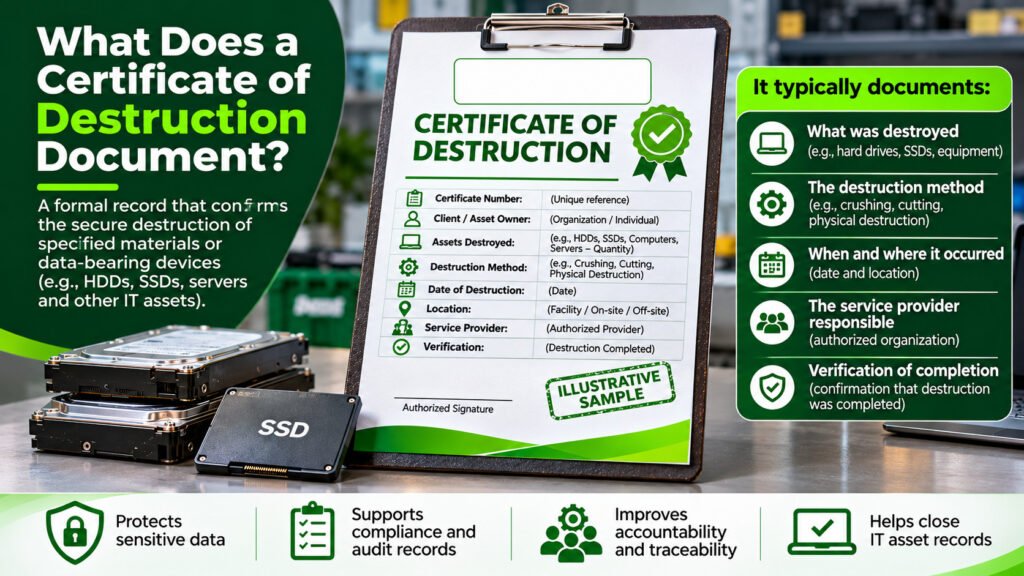
A Certificate of Destruction records the destruction of specified materials or data-bearing devices. It typically identifies what was destroyed, the destruction method, when and where the process occurred, and the organization responsible.
This documentation helps businesses maintain accountability, demonstrate responsible information handling, and support security audits.
What Is a Certificate of Destruction?
A Certificate of Destruction is a formal record issued by a destruction service provider or responsible organization after specified materials or equipment have been destroyed.
In electronic waste management and secure data destruction, certificates are commonly used for hard disk drives (HDDs), solid-state drives (SSDs), servers, storage media, and other assets containing confidential information.
The certificate provides documented confirmation of the destruction activity. However, its reliability depends on accurate asset records, appropriate destruction methods, and supporting verification.
What Information Does a Certificate of Destruction Document?
A well-prepared Certificate of Destruction should contain enough information to identify the destruction job and establish what occurred.
| Information | What it documents |
|---|---|
| Certificate number | A unique reference for tracking and verification |
| Client or asset owner | The organization authorizing the destruction |
| Asset details | Equipment type, quantity, and identifying information |
| Serial numbers | Individual device identification, where applicable |
| Destruction method | How the equipment or storage media was destroyed |
| Date and location | When and where destruction took place |
| Service provider | The organization responsible for the process |
| Verification and authorization | The recorded confirmation of completion and responsible signatory |
For large-scale IT disposal projects, a separate asset report may accompany the certificate to provide detailed serial-number records and destruction results.
Why Is a Certificate of Destruction Important?
A Certificate of Destruction serves several important purposes.
1. Protecting confidential information
Businesses handle customer records, financial information, employee details, and other sensitive data. Proper destruction procedures help prevent unauthorized access when storage devices reach the end of their useful life.
Learn more about hard drive destruction.
2. Supporting compliance and audits
Organizations may need evidence showing how sensitive information was handled during disposal.
The UK Information Commissioner’s Office (ICO) recommends obtaining appropriate evidence of secure disposal from third-party providers and checking destruction certificates against the assets sent for destruction.
Legal and regulatory requirements vary by country and industry. A certificate supports compliance documentation but does not automatically establish compliance.
3. Improving accountability
Certificates provide an identifiable record of the service provider, completed activity, and assets covered. When combined with collection records and chain-of-custody documentation, they help organizations trace equipment through the disposal process.
4. Supporting IT asset management
Certificates help IT departments close asset retirement records and demonstrate that equipment designated for destruction was handled according to the organization’s disposal instructions.
This is particularly relevant in IT asset disposal and disposition (ITAD).
Which Destruction Methods May Be Documented?
The method recorded depends on the equipment, security requirements, and agreed service.
Common methods include physical crushing, cutting, shredding, and other appropriate processes that render the targeted storage media unusable.
Secure data erasure is different from physically destroying a device. Where information is securely erased while the equipment remains reusable, a Certificate of Sanitization or Data Erasure may be a more precise document.
The NIST SP 800-88 Revision 2 Guidelines for Media Sanitization provide guidance for selecting suitable sanitization methods and controls based on the sensitivity of information.
Importantly, a certificate should describe the method actually performed rather than imply that every possible destruction process was used.
Certificate of Destruction vs. Certificate of Recycling
Although both documents may be issued during electronic waste management, they serve different purposes.
| Certificate of Destruction | Certificate of Recycling |
|---|---|
| Documents specified destruction activities | Documents recycling or material recovery activities |
| Focuses on destruction of designated assets or materials | Focuses on processing discarded materials |
| May include serial numbers and destruction methods | May include material types, quantities, and recycling information |
For example, an organization retiring old computers may receive a Certificate of Destruction for the storage drives and separate recycling documentation for the remaining electronic components.
Explore computer recycling to understand how equipment can be managed after retirement.
How Can You Verify a Certificate of Destruction?
Before accepting a certificate, an organization should confirm that the details match its disposal records.
Check the certificate reference number, equipment quantities, identifying details, destruction method, date, and issuing organization.
Where applicable, review supporting records such as asset inventories, chain-of-custody forms, witness records, or photographs.
Any equipment that was not successfully destroyed should be clearly identified rather than reported as completed.
A certificate is valuable supporting evidence, but its existence alone does not independently prove that every destruction step was performed correctly.
Frequently Asked Questions
Is a Certificate of Destruction legally required?
Requirements depend on the country, industry, type of information, and applicable regulations or contractual obligations. Even where a specific certificate is not mandatory, documented evidence of secure destruction can support an organization’s accountability.
Does a Certificate of Destruction mean data cannot be recovered?
Not automatically. Data security depends on the effectiveness of the actual destruction or sanitization method and its verification. The certificate records the process and outcome reported by the issuer.
Can a Certificate of Destruction include serial numbers?
Yes. Serial numbers help identify the specific storage devices covered by the certificate. For large quantities, the information may be provided in an accompanying asset report.
When should a Certificate of Destruction be issued?
A final certificate should be issued after the relevant destruction work has been completed and the recorded results have been confirmed.
Is a Certificate of Destruction the same as a chain-of-custody document?
No. A chain-of-custody record tracks the possession and transfer of equipment, while a Certificate of Destruction documents the destruction activity. Together, they provide a more complete audit trail.