IT Equipment Disposal in Germany: What Every Business Should Know
An outdated laptop, a retired server or a storage room filled with unused computers may seem like an ordinary workplace problem. However, for businesses in Germany, disposing of old IT equipment involves much more than simply removing unwanted electronics.
From environmental regulations and data protection to equipment reuse and responsible recycling, organizations must consider what happens to their technology after it reaches the end of its useful life.
Understanding these responsibilities can help businesses reduce security risks, protect the environment and maintain accountable IT asset management practices.
1. Understand Germany’s Electronic Waste Regulations
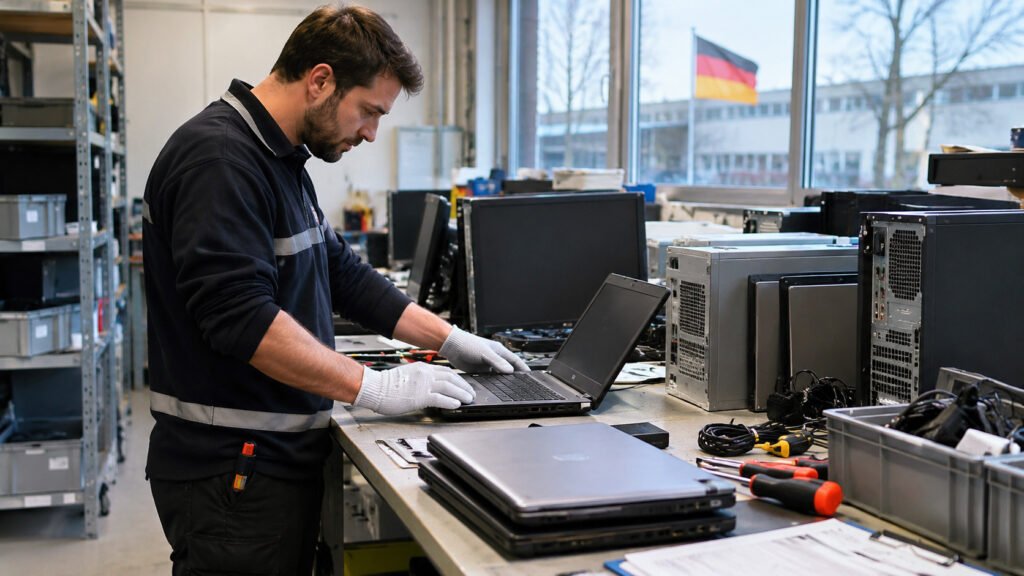
Germany regulates electronic waste through the Electrical and Electronic Equipment Act (ElektroG), known in German as the Elektro- und Elektronikgerätegesetz.
The legislation implements the European Union’s WEEE Directive, which promotes responsible collection, treatment, reuse and recycling of electrical and electronic equipment.
Businesses should understand that:
- Electronic waste must be collected separately from general waste.
- Manufacturers must provide appropriate take-back options for qualifying business equipment.
- Initial treatment of electronic waste must take place at appropriately certified facilities.
- Businesses arranging their own disposal remain responsible for ensuring proper treatment.
- Equipment should be assessed for potential reuse where technically and economically appropriate.
Businesses that manufacture, import or place electrical equipment on the German market may have additional registration and producer responsibilities.
Further information is available through the German Environment Agency’s ElektroG guidance.
2. Identify Which IT Equipment Needs Disposal
Business electronic waste includes more than outdated desktop computers.
| Equipment category | Common examples |
|---|---|
| Computing equipment | Laptops, desktops and workstations |
| Data storage | HDDs, SSDs and backup tapes |
| Data centre equipment | Servers and storage arrays |
| Networking equipment | Routers, switches and firewalls |
| Office electronics | Printers, scanners and photocopiers |
| Display equipment | Monitors and digital screens |
| Power equipment | UPS systems, batteries and power supplies |
| Communication devices | Smartphones, tablets and office telephones |
Creating an equipment inventory helps businesses identify data security risks, hazardous components and potential reuse opportunities before collection.
Explore more about business computer recycling.
3. Protect Business Data Before Recycling
One of the greatest risks associated with IT equipment disposal is the information that remains stored on retired devices.
Old computers, servers, smartphones and even multifunction printers may contain customer information, employee records, financial documents, passwords and confidential business data.
Under the General Data Protection Regulation (GDPR), organizations must apply appropriate safeguards to protect personal information against unauthorized access and disclosure.
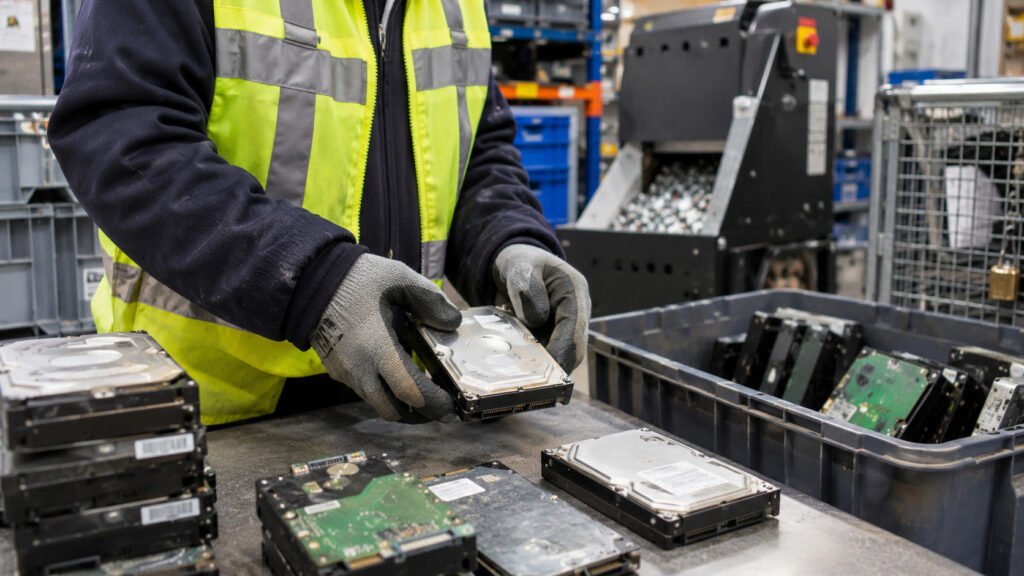
Depending on the equipment and sensitivity of the information, suitable data sanitization methods may include:
- Verified data wiping.
- Cryptographic erasure.
- Physical destruction of storage media.
- Degaussing of suitable magnetic storage media.
- A combination of logical sanitization and physical destruction.
Simply deleting files, formatting a drive or performing an ordinary factory reset does not necessarily make stored information unrecoverable.
Organizations can consult NIST SP 800-88 Revision 2 for internationally recognized media sanitization guidance and the official GDPR legislation for European data protection requirements.
Related reading: Secure data destruction and hard drive destruction.
4. Decide Whether Equipment Should Be Reused or Recycled
Not every retired electronic device has reached the end of its functional life.
Equipment may still be suitable for refurbishment, internal redeployment, donation or reuse after appropriate security checks and data sanitization.
| Equipment condition | Possible treatment |
|---|---|
| Fully functional | Reuse or redeployment |
| Repairable | Repair or refurbishment |
| Obsolete or beyond repair | Material recycling |
| Data-bearing and highly sensitive | Secure sanitization or destruction |
| Hazardous or damaged components | Specialized treatment |
Extending the life of suitable electronics reduces demand for virgin raw materials and supports the circular economy.
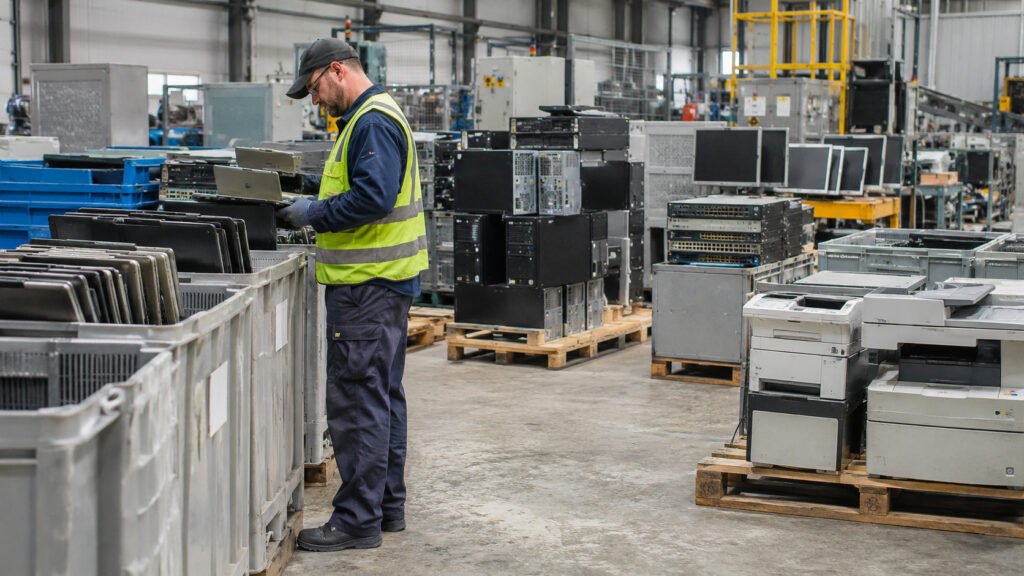
However, reuse decisions must also consider information security, contractual obligations and organizational disposal policies.
5. Choose a Responsible IT Disposal Provider
Businesses should establish where their equipment will go, how it will be processed and who will be responsible for its handling.
Under Section 21 of ElektroG, initial treatment of electronic waste must be performed by certified first-treatment facilities, known in Germany as Erstbehandlungsanlagen (EBA).
Before selecting a provider, businesses should examine:
- Relevant environmental certifications and authorizations.
- Secure collection and transportation procedures.
- Data sanitization and destruction capabilities.
- Equipment tracking and chain-of-custody records.
- Downstream recycling arrangements.
- Availability of disposal and destruction documentation.
Germany’s stiftung ear official registers provide information about registered producers and first-treatment facilities.
6. Understand the Cost of Business Electronics Disposal
Is business e-waste disposal free in Germany? Not necessarily.
Under Section 19 of ElektroG, producers generally bear disposal costs for qualifying B2B electronic waste returned through their arrangements. Exceptions include certain historical equipment and alternative contractual agreements.
Additional services such as secure transportation, on-site data destruction, detailed asset tracking and specialized handling may also affect the overall cost.
Businesses should check manufacturer take-back arrangements and existing supplier agreements before commissioning independent disposal services.
Read the official provisions under Section 19 of ElektroG.
7. Maintain Proper Disposal Documentation
Responsible IT equipment disposal should leave a clear record of what happened to each relevant asset.
Depending on regulatory, contractual and organizational requirements, useful documentation may include:
- Equipment inventory and serial number records.
- Collection and transportation records.
- Chain-of-custody documentation.
- Data sanitization verification reports.
- Certificates of Data Destruction.
- Recycling and disposal records.
- Final asset disposition reports.
These records support internal audits, environmental reporting, information security management and corporate accountability.
A certificate alone, however, does not automatically establish full GDPR or environmental compliance. The underlying processes must also be appropriate and verifiable.
8. Adopt a Structured IT Asset Disposition Process
For organizations managing multiple offices, large technology inventories or data centres, IT Asset Disposition (ITAD) provides a structured approach to retiring equipment.
A typical process involves:
- Equipment identification and inventory.
- Assessment of condition and data security risks.
- Secure collection and transportation.
- Data sanitization or destruction.
- Authorized reuse or responsible recycling.
- Verification and final documentation.
This approach helps businesses connect information security, environmental responsibility and technology lifecycle management.
Learn more about IT asset disposal and electronic waste management services.
Frequently Asked Questions
Can businesses put old computers in general waste in Germany?
No. Waste electrical and electronic equipment must be collected separately and directed through appropriate collection and treatment channels.
Does GDPR require all hard drives to be physically destroyed?
No. GDPR requires appropriate protection of personal data but does not prescribe physical destruction for every storage device. Verified sanitization may be suitable depending on the risks involved.
Can businesses donate old computers in Germany?
Yes. Functional equipment may be donated or reused, provided ownership, data security, safety and applicable legal requirements are addressed.
Do businesses need a Certificate of Data Destruction?
A certificate is valuable evidence of completed data destruction and may be required by contracts or internal policies. GDPR does not universally prescribe a certificate for every retired device.
Is IT equipment disposal regulated throughout Europe?
Yes. EU member states implement the WEEE Directive through their respective national legislation. Germany applies its requirements through ElektroG, while other countries have their own implementation frameworks.
Conclusion
Disposing of old IT equipment in Germany is an important part of responsible business management. It requires organizations to consider environmental legislation, information security, equipment reuse and proper documentation.
Although disposal regulations differ between countries, the fundamental principles remain relevant worldwide: protect sensitive data, extend equipment life where appropriate, recycle responsibly and maintain transparent records.
Nalabix Eco supports responsible electronics recycling, secure data destruction and IT asset disposition through its international operations and business partnerships across Europe, Africa and North America.
Discover more about Nalabix Eco and responsible IT equipment management.