What Does a Certificate of Destruction Document
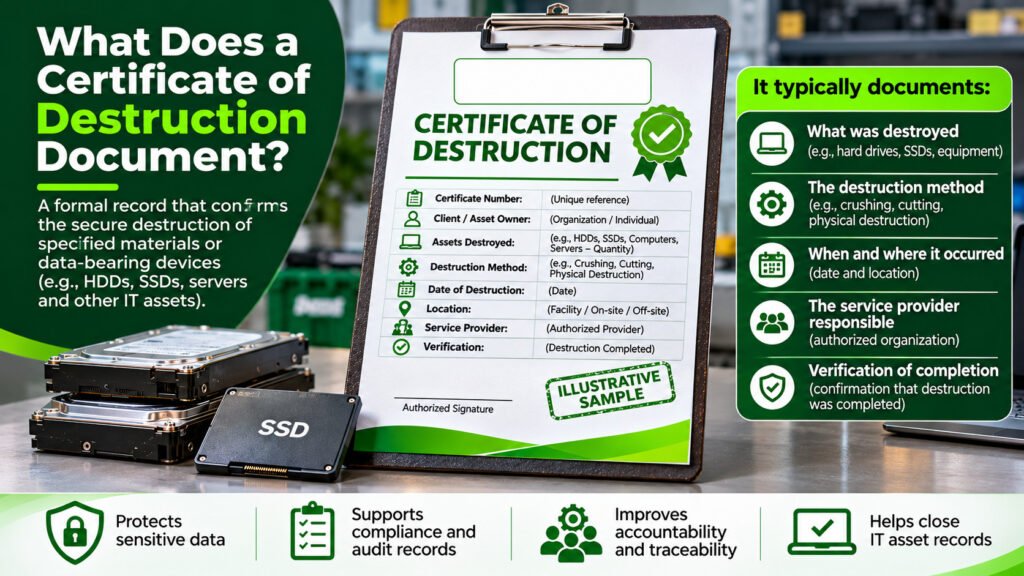
When a business disposes of old computers, hard drives, servers, or other equipment containing sensitive information, how can it demonstrate that the data was securely destroyed? One important document is a Certificate of Destruction (CoD). A Certificate of Destruction records the destruction of specified materials or data-bearing devices. It typically identifies what was destroyed, the destruction method, when and where the process occurred, and the organization responsible. This documentation helps businesses maintain accountability, demonstrate responsible information handling, and support security audits. What Is a Certificate of Destruction? A Certificate of Destruction is a formal record issued by a destruction service provider or responsible organization after specified materials or equipment have been destroyed. In electronic waste management and secure data destruction, certificates are commonly used for hard disk drives (HDDs), solid-state drives (SSDs), servers, storage media, and other assets containing confidential information. The certificate provides documented confirmation of the destruction activity. However, its reliability depends on accurate asset records, appropriate destruction methods, and supporting verification. What Information Does a Certificate of Destruction Document? A well-prepared Certificate of Destruction should contain enough information to identify the destruction job and establish what occurred. Information What it documents Certificate number A unique reference for tracking and verification Client or asset owner The organization authorizing the destruction Asset details Equipment type, quantity, and identifying information Serial numbers Individual device identification, where applicable Destruction method How the equipment or storage media was destroyed Date and location When and where destruction took place Service provider The organization responsible for the process Verification and authorization The recorded confirmation of completion and responsible signatory For large-scale IT disposal projects, a separate asset report may accompany the certificate to provide detailed serial-number records and destruction results. Why Is a Certificate of Destruction Important? A Certificate of Destruction serves several important purposes. 1. Protecting confidential information Businesses handle customer records, financial information, employee details, and other sensitive data. Proper destruction procedures help prevent unauthorized access when storage devices reach the end of their useful life. Learn more about hard drive destruction. 2. Supporting compliance and audits Organizations may need evidence showing how sensitive information was handled during disposal. The UK Information Commissioner’s Office (ICO) recommends obtaining appropriate evidence of secure disposal from third-party providers and checking destruction certificates against the assets sent for destruction. Legal and regulatory requirements vary by country and industry. A certificate supports compliance documentation but does not automatically establish compliance. 3. Improving accountability Certificates provide an identifiable record of the service provider, completed activity, and assets covered. When combined with collection records and chain-of-custody documentation, they help organizations trace equipment through the disposal process. 4. Supporting IT asset management Certificates help IT departments close asset retirement records and demonstrate that equipment designated for destruction was handled according to the organization’s disposal instructions. This is particularly relevant in IT asset disposal and disposition (ITAD). Which Destruction Methods May Be Documented? The method recorded depends on the equipment, security requirements, and agreed service. Common methods include physical crushing, cutting, shredding, and other appropriate processes that render the targeted storage media unusable. Secure data erasure is different from physically destroying a device. Where information is securely erased while the equipment remains reusable, a Certificate of Sanitization or Data Erasure may be a more precise document. The NIST SP 800-88 Revision 2 Guidelines for Media Sanitization provide guidance for selecting suitable sanitization methods and controls based on the sensitivity of information. Importantly, a certificate should describe the method actually performed rather than imply that every possible destruction process was used. Certificate of Destruction vs. Certificate of Recycling Although both documents may be issued during electronic waste management, they serve different purposes. Certificate of Destruction Certificate of Recycling Documents specified destruction activities Documents recycling or material recovery activities Focuses on destruction of designated assets or materials Focuses on processing discarded materials May include serial numbers and destruction methods May include material types, quantities, and recycling information For example, an organization retiring old computers may receive a Certificate of Destruction for the storage drives and separate recycling documentation for the remaining electronic components. Explore computer recycling to understand how equipment can be managed after retirement. How Can You Verify a Certificate of Destruction? Before accepting a certificate, an organization should confirm that the details match its disposal records. Check the certificate reference number, equipment quantities, identifying details, destruction method, date, and issuing organization. Where applicable, review supporting records such as asset inventories, chain-of-custody forms, witness records, or photographs. Any equipment that was not successfully destroyed should be clearly identified rather than reported as completed. A certificate is valuable supporting evidence, but its existence alone does not independently prove that every destruction step was performed correctly. Frequently Asked Questions Is a Certificate of Destruction legally required? Requirements depend on the country, industry, type of information, and applicable regulations or contractual obligations. Even where a specific certificate is not mandatory, documented evidence of secure destruction can support an organization’s accountability. Does a Certificate of Destruction mean data cannot be recovered? Not automatically. Data security depends on the effectiveness of the actual destruction or sanitization method and its verification. The certificate records the process and outcome reported by the issuer. Can a Certificate of Destruction include serial numbers? Yes. Serial numbers help identify the specific storage devices covered by the certificate. For large quantities, the information may be provided in an accompanying asset report. When should a Certificate of Destruction be issued? A final certificate should be issued after the relevant destruction work has been completed and the recorded results have been confirmed. Is a Certificate of Destruction the same as a chain-of-custody document? No. A chain-of-custody record tracks the possession and transfer of equipment, while a Certificate of Destruction documents the destruction activity. Together, they provide a more complete audit trail.
What Happens to Electronics After Collection? The E-Waste Recycling Journey
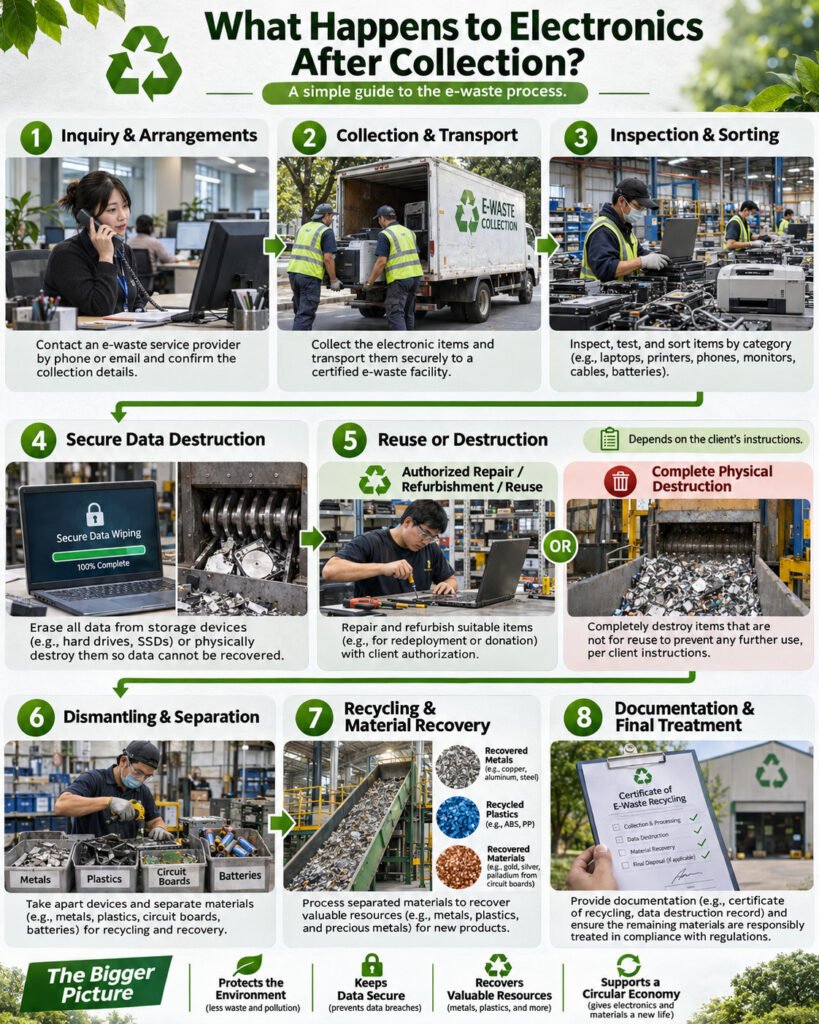
Have you ever wondered where your old computers, phones, printers, or other electronic devices go after collection? Electronic waste (e-waste) does not simply disappear. It goes through several stages of handling, sorting, data protection, dismantling, and recycling to recover valuable materials and prevent environmental harm. Here’s what typically happens behind the scenes. Here’s what typically happens behind the scenes. 1. E-Waste Collection Inquiry and Arrangements The electronic waste recycling journey begins when individuals, households, businesses, or institutions contact an e-waste management service provider to arrange collection of unwanted electronics. During the inquiry, details such as the type of equipment, quantity, collection location, and special handling requirements are discussed. Once the arrangements are confirmed, a collection is scheduled. The electronic waste is then collected from the agreed location and transported to a designated collection center or processing facility. For organizations, this stage may also involve asset inventories, handover records, and chain-of-custody documentation to ensure accountability. 2. Inspection and Sorting of Electronic Waste Upon arrival at the processing facility, collected electronics are inspected and sorted according to their type, condition, and handling requirements. Computers, smartphones, batteries, printers, circuit boards, and other electronic components may require different recycling methods. Sorting helps identify equipment suitable for authorized reuse, materials that can be recovered, and components requiring specialized treatment.able components, recoverable materials, hazardous substances, and equipment designated for destruction. 3. Secure Data Destruction Many electronic devices contain personal, financial, or confidential business information. Before data-bearing equipment is reused or recycled, appropriate measures should be taken to protect sensitive information. Depending on the device, client requirements, and security needs, data may be securely erased using specialized sanitization procedures or destroyed through physical methods such as crushing or cutting. Secure data destruction is particularly important for businesses, financial institutions, healthcare providers, and organizations handling confidential information. 4. Refurbishment, Reuse, or Complete Destruction Not all collected electronics follow the same recycling pathway. The decision to refurbish, reuse, or destroy equipment depends on its condition, the client’s instructions, contractual obligations, and applicable regulations. Where authorized, functional electronics may be repaired or refurbished to extend their useful life. However, some clients require complete physical destruction of their electronic equipment, with no reuse, resale, or refurbishment permitted. In such cases, the equipment is directed for appropriate physical destruction, after which recoverable materials may be separated for recycling. This ensures that the handling process respects the client’s disposal and security requirements. 5. Dismantling and Material Separation Electronics designated for recycling are dismantled or mechanically processed to separate their components. Common materials include: Proper separation improves material recovery and supports safer downstream processing. 6. Recycling and Material Recovery Separated materials are transferred to appropriate recycling and recovery processes. Metals may be refined and returned to manufacturing supply chains. Suitable plastics can be reprocessed, while circuit boards may be treated by specialized facilities to recover valuable metals. This process supports the circular economy by recovering resources from discarded electronics instead of relying entirely on newly extracted materials. Not every component is recyclable, so residual and hazardous materials must be managed using suitable treatment or disposal methods. 7. Final Disposal and Documentation Some electronic components contain substances that require specialized handling to prevent environmental contamination and health risks. For example, lithium-ion batteries can present fire hazards, while certain older electronic devices may contain lead, mercury, or other hazardous substances. These materials must be separated and directed to suitable treatment or disposal facilities in accordance with applicable environmental regulations. Proper handling helps prevent pollution caused by unsafe dumping, burning, or dismantling practices. Frequently Asked Questions Are all collected electronics recycled? No. Depending on their condition and the client’s instructions, electronics may be reused, refurbished, physically destroyed, recycled for material recovery, or sent for appropriate final treatment. What happens to electronics that must be completely destroyed? Equipment designated for destruction is processed using suitable physical destruction methods to prevent further use. Recoverable materials may then be separated and recycled. Can valuable materials be recovered from broken electronics? Yes. Even non-functional electronics may contain recoverable copper, aluminum, steel, and precious metals. Bottom line The journey of electronic waste begins with a collection inquiry and continues through transportation, sorting, secure data handling, dismantling, material recovery, and responsible final treatment. Whether equipment is refurbished, recycled, or completely destroyed, the process should follow the client’s requirements and appropriate environmental and security practices. Responsible e-waste management is not just about collecting unwanted electronics. It is about ensuring they are properly handled from the initial inquiry to their final destination. At Nalabix Eco, we support responsible electronic waste management through e-waste collection, recycling, secure data destruction, and IT asset disposal services. Recycle responsibly. Protect your data. Preserve valuable resources.
What Counts as Electronic Waste?
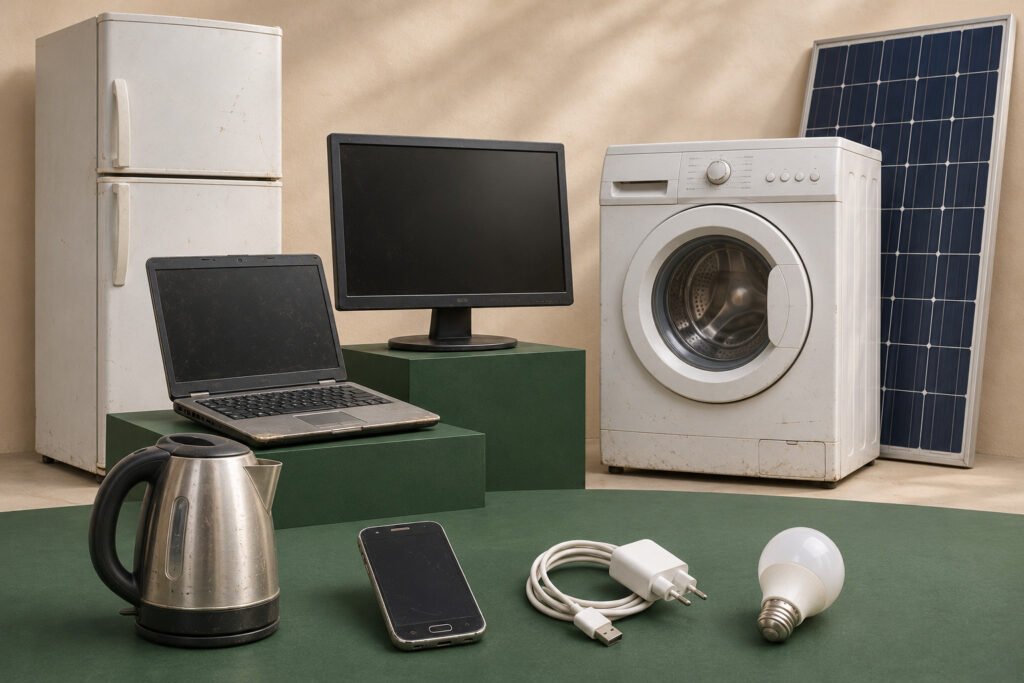
A cracked phone is an obvious example of electronic waste. But what about a broken kettle, a box of old chargers or a refrigerator that no longer cools? These can all count as e-waste. The term covers everyday electrical appliances as well as computers and other digital devices. What is electronic waste? Electronic waste, or e-waste, is electrical or electronic equipment and its parts that have been discarded as waste. You may also see the term WEEE, which stands for waste electrical and electronic equipment. A device’s age and condition can help you decide what to do with it, but what matters for this definition is whether it’s being discarded. A working printer sent for recycling can count as e-waste, while a working printer passed on for someone else to use is second-hand equipment. Common examples of e-waste Category Examples Computers and communications equipment Desktop computers, smartphones, routers and printers Screens and monitors Televisions, computer monitors, laptops and tablets Cooling equipment Refrigerators, freezers and air conditioners Large electrical equipment Washing machines, dishwashers and solar panels Small electrical equipment Kettles, toasters, electric shavers and battery-powered toys Lighting LED bulbs and fluorescent tubes These examples follow the broad categories used in the Global E-waste Monitor. The items an individual collection programme accepts can vary by location. What about chargers, cables and batteries? Chargers and cables are easy to overlook when clearing out a drawer or an office storeroom. Check whether your local electronics collection service accepts them alongside devices. Loose batteries may need a separate drop-off, and devices with built-in rechargeable batteries may have specific collection instructions. Keep lithium-ion batteries and devices containing them out of household rubbish and mixed recycling bins. What should you do with unwanted electronics? A simple rule for your next clear-out: if an item uses electricity or batteries and you’re ready to discard it, check your local e-waste guidance first. That applies to the charger in your drawer just as much as the fridge in your kitchen.
What Is Considered E-Waste? Complete Guide to Electronic Waste Recycling in Kenya
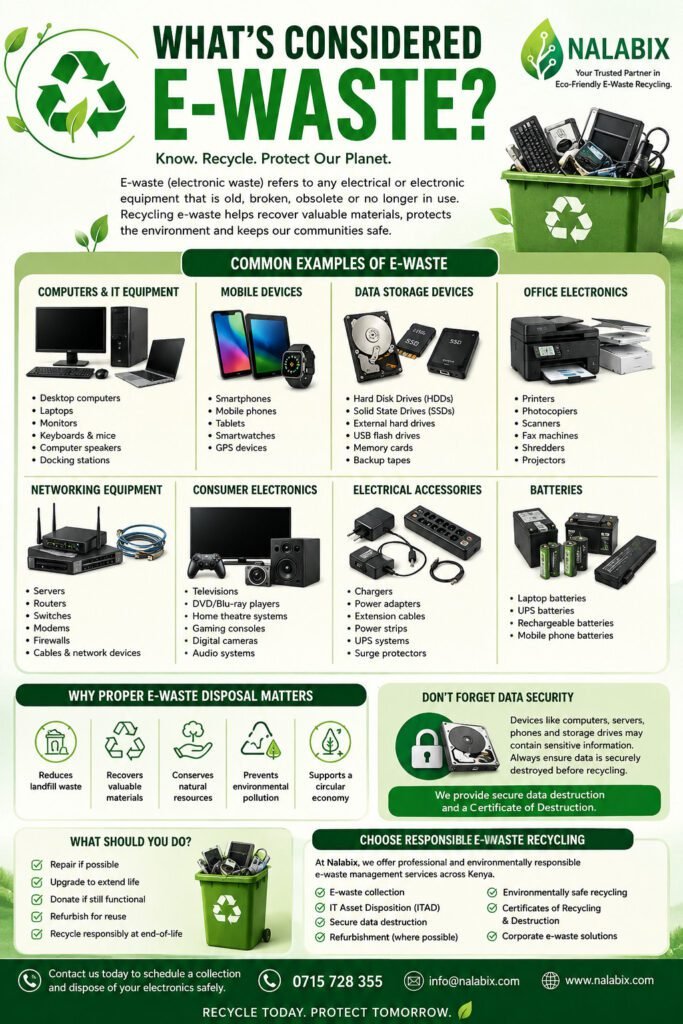
What’s Considered E-Waste? A Complete Guide to Electronic Waste As technology continues to evolve, we replace our electronic devices more frequently than ever before. But what happens to the old laptops, phones, printers, and other electronics we no longer use? These items become electronic waste (e-waste) and require responsible disposal to protect the environment and safeguard sensitive data. Understanding what qualifies as e-waste is the first step toward making environmentally responsible decisions. What Is E-Waste? Electronic waste (e-waste) refers to any electrical or electronic equipment that has reached the end of its useful life, is broken, obsolete, or no longer wanted. If a device requires electricity, batteries, or a power source to operate, it will likely become e-waste when it can no longer be used. Improper disposal of e-waste can release hazardous substances into the environment, while valuable materials such as copper, aluminum, steel, gold, and other recoverable metals may be lost instead of recycled. Common Examples of E-Waste Computers and IT Equipment Mobile Devices Data Storage Devices Office Electronics Networking Equipment Consumer Electronics Electrical Accessories Batteries Why Proper E-Waste Disposal Matters Many electronic devices contain materials that require careful handling. When discarded in open dumps or mixed with general waste, they can contribute to environmental pollution and create health risks. Responsible e-waste recycling helps to: Don’t Forget About Data Security Many electronic devices store confidential information even after files have been deleted. These include: Before recycling these devices, it is important to ensure that all data is securely destroyed using professional data destruction methods. Businesses should work with certified e-waste recyclers that provide secure data destruction and a Certificate of Destruction for sensitive storage devices. What Should You Do With Old Electronics? Before disposing of electronic equipment, consider the following options: Responsible recycling ensures valuable materials are recovered while hazardous components are handled safely. E-Waste Recycling in Kenya As Kenya continues to embrace digital transformation, the volume of electronic waste generated by businesses, institutions, and households is growing every year. Proper e-waste management is essential for protecting the environment, supporting resource recovery, and meeting environmental compliance requirements. Organizations should partner with licensed e-waste recycling companies that provide secure collection, environmentally responsible recycling, data destruction services, and documentation confirming proper disposal. Choose Responsible E-Waste Recycling At Nalabix, we provide professional e-waste recycling services across Kenya for businesses, schools, hospitals, government institutions, and individuals. Our services include: Whether you’re replacing a single laptop or decommissioning an entire data centre, responsible e-waste management protects your data, supports sustainability, and helps build a cleaner future. Need professional e-waste recycling in Kenya? Contact Nalabix today to schedule a collection and dispose of your electronics safely, securely, and responsibly.