IT Asset Disposal vs IT Asset Disposition: What’s the Difference?
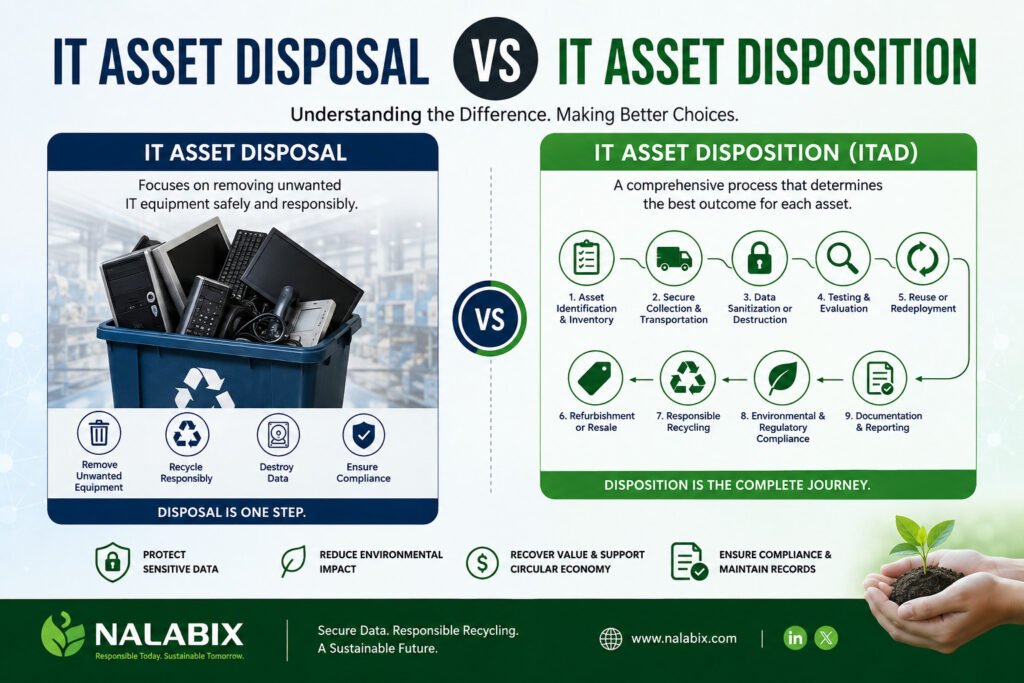
Businesses regularly replace computers, servers, storage devices, networking equipment, and other technology. But what happens to those assets after they are no longer needed? Two terms are often used interchangeably: IT Asset Disposal (ITADisposal) and IT Asset Disposition (ITAD). Although they sound similar, they can describe very different approaches to handling retired technology. Understanding the difference can help organizations protect sensitive data, reduce environmental impact, recover value where appropriate, and maintain proper records. What Is IT Asset Disposal? IT Asset Disposal generally refers to the process of getting rid of IT equipment that is no longer required, useful, or supported. This may involve: The main focus of disposal is removing unwanted IT assets safely and responsibly. However, simply throwing equipment away is not responsible IT asset disposal. Devices can contain sensitive information, hazardous materials, and recyclable resources. What Is IT Asset Disposition (ITAD)? IT Asset Disposition (ITAD) is a broader and more structured process for managing technology at the end of its useful life. ITAD can cover the entire journey from identifying retired assets to their final disposition. Depending on the asset and organizational requirements, this may include: The goal is not simply to get rid of equipment. It is to determine the most secure, compliant, environmentally responsible, and economically appropriate outcome for each asset. IT Asset Disposal vs. IT Asset Disposition The easiest way to understand the difference is to think of disposal as one possible outcome within the broader ITAD process. IT Asset Disposal IT Asset Disposition Focuses on removing unwanted equipment Covers the complete end-of-life process Often emphasizes recycling or disposal Considers reuse, recycling, destruction and other outcomes Can be a single activity Usually involves multiple controlled stages May focus mainly on the physical asset Considers data, environmental, compliance and asset value Documentation may be limited Typically includes detailed tracking and reporting In simple terms: IT Asset Disposal = getting rid of unwanted IT equipment responsibly. IT Asset Disposition = managing the entire lifecycle of retired IT assets toward their appropriate final outcome. Why Data Security Matters A retired computer, server, hard drive, SSD, or mobile device may still contain confidential information. Deleting files or performing a factory reset does not necessarily provide adequate assurance that data cannot be recovered. A responsible ITAD program should therefore include appropriate data sanitization or physical destruction based on the organization’s security requirements. For organizations handling sensitive information, documentation such as certificates of data destruction or sanitization records can also provide valuable evidence that the process was completed. Which Approach Should Businesses Use? For small organizations with a limited number of devices, straightforward IT asset disposal may be sufficient when handled securely and responsibly. For organizations managing larger technology environments, IT Asset Disposition (ITAD) provides a more comprehensive approach. ITAD is particularly valuable when an organization needs: Bottom line The terms IT Asset Disposal and IT Asset Disposition are closely related, but they are not exactly the same. Disposal generally focuses on the responsible removal or recycling of unwanted IT equipment. IT Asset Disposition (ITAD) takes a broader approach, covering asset tracking, data security, reuse, recycling, environmental responsibility, compliance, and final disposition. For modern organizations, the objective should not simply be to dispose of old technology. It should be to ensure that every retired IT asset reaches its appropriate final destination securely, responsibly, and with proper accountability. Responsible IT asset management protects data, people, resources, and the environment.