
Electronic waste, or e-waste, is one of the fastest-growing waste streams in the world. Every year, households, businesses, governments, and industries replace millions of computers, phones, televisions, appliances, and other electronic devices.
But which countries produce the most e-waste?
The answer is closely linked to population size, technology use, consumer purchasing power, and how frequently electronic products are replaced. Understanding where the largest amounts of e-waste are generated helps governments, businesses, and recyclers develop better collection and recycling systems.
What Is E-Waste?
E-waste refers to discarded electrical and electronic equipment and its components. It includes products that are broken, obsolete, unwanted, or reaching the end of their useful life.
Common examples include:
- Computers and laptops
- Mobile phones and tablets
- Televisions and monitors
- Printers and photocopiers
- Refrigerators and washing machines
- Air conditioners
- Cables and chargers
- Servers and networking equipment
- Batteries and electronic accessories
Although these products contain valuable materials such as copper, aluminium, steel, gold, and other recoverable resources, some also contain substances that require careful handling and controlled recycling.
Countries That Generate the Most E-Waste
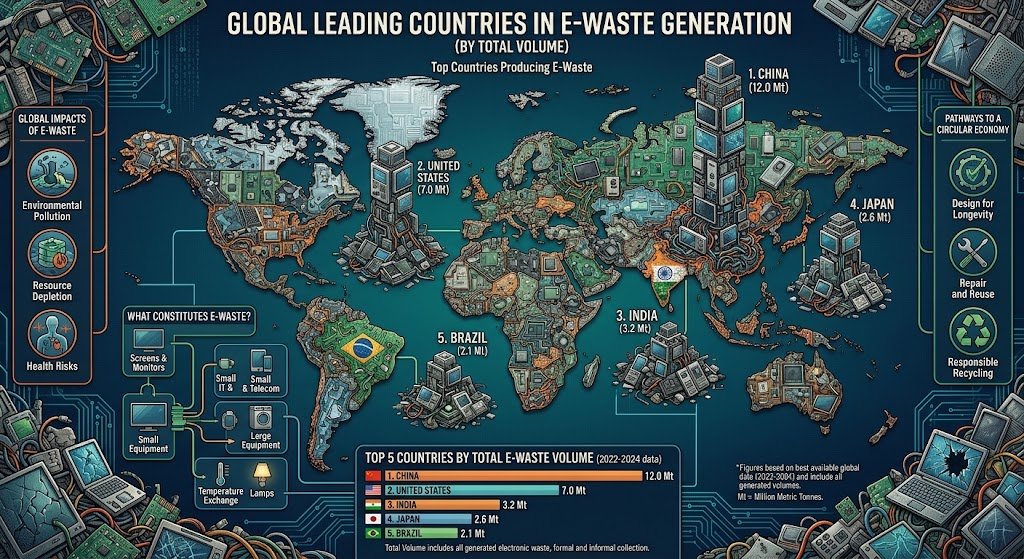
According to international e-waste assessments, China, the United States, India, Japan, and Brazil are among the world’s largest e-waste-generating countries by total volume.
1. China
China generates the largest amount of e-waste globally in absolute terms. Its huge population, extensive electronics manufacturing industry, rapid technological development, and high domestic consumption all contribute to the country’s large e-waste stream.
The country has also invested heavily in formal recycling infrastructure and policies designed to improve the management of discarded electronics.
2. United States
The United States is another major generator of electronic waste.
High levels of electronics ownership, frequent device replacement, and strong consumer demand for newer technology contribute significantly to its e-waste generation.
Computers, smartphones, televisions, household appliances, and other consumer electronics make up a substantial portion of the waste stream.
3. India
India’s rapidly growing economy, large population, increasing access to technology, and expanding use of electrical and electronic equipment have contributed to significant growth in e-waste generation.
The country faces the challenge of expanding formal collection and recycling systems as more electronics reach the end of their useful lives.
4. Japan
Japan is a highly developed and technology-intensive economy with widespread use of electrical and electronic products.
Although its total e-waste volume is smaller than that of China, the United States, and India, Japan has developed structured systems for managing and recycling many categories of electronic products.
5. Brazil
Brazil is one of the largest e-waste generators in Latin America.
Its large population, growing electronics market, and increasing consumption of electrical and electronic equipment contribute to substantial e-waste generation.
Improving collection networks and increasing public participation in formal recycling remain important parts of managing the growing waste stream.
Why Do Some Countries Produce More E-Waste?
E-waste generation is not determined by population alone. Several factors influence how much electronic waste a country produces.
Population Size
Countries with large populations naturally have more consumers using electronic products. Even a relatively small amount of e-waste per person can result in a large national total.
Consumer Electronics Use
Countries where computers, smartphones, televisions, appliances, and other electronics are widely used tend to generate more discarded equipment.
Device Replacement Rates
Technology changes quickly. Consumers and organizations may replace functioning equipment because newer products offer improved performance, features, energy efficiency, or compatibility.
Economic Development
Higher-income economies generally have greater access to electrical and electronic equipment. As ownership increases, so does the amount of equipment eventually reaching end of life.
Business and Industrial Activity
Businesses, data centers, telecommunications companies, financial institutions, manufacturers, and other organizations can generate significant quantities of obsolete IT equipment and electronic components.
Total E-Waste vs E-Waste Per Person
There is an important difference between total e-waste generation and e-waste generated per person.
A country with a very large population may generate the most e-waste overall, even if the amount generated per person is relatively moderate.
Meanwhile, smaller and wealthier countries can generate comparatively high amounts of e-waste per capita.
This distinction is important when comparing countries because total volume shows the scale of the national waste challenge, while per-capita figures provide insight into consumption and disposal patterns.
Where Does All This E-Waste Go?
Not all discarded electronics are managed in the same way.
Depending on the country and waste management system, e-waste may be:
- Reused or refurbished
- Collected through formal recycling programs
- Dismantled for material recovery
- Stored by households or businesses
- Processed by informal recycling networks
- Exported or transported across borders
- Disposed of through inappropriate waste channels
Formal recycling is important because electronic equipment contains both valuable resources and potentially hazardous components.
Proper processing allows materials to be recovered while reducing environmental and occupational risks.
Why E-Waste Recycling Matters
Recycling electronics is not simply about getting rid of old devices. It is also about recovering resources and reducing the environmental impact associated with producing new materials.
Responsible e-waste recycling can help:
- Recover valuable metals and materials
- Reduce the need for virgin resource extraction
- Keep hazardous components out of inappropriate disposal channels
- Reduce pressure on landfills
- Support a circular economy
- Create opportunities for reuse and refurbishment
- Improve responsible management of obsolete technology
For businesses, proper electronic waste management can also support environmental compliance, responsible asset disposal, and secure handling of data-bearing equipment.
The Global E-Waste Challenge
The countries generating the most e-waste demonstrate the scale of the global electronics challenge. However, e-waste is not only a problem for the largest generators.
As access to technology continues to expand across Africa, Asia, Latin America, and other emerging markets, more countries are expected to face growing volumes of discarded electrical and electronic equipment.
The solution requires more than simply recycling more devices. Countries need effective collection systems, responsible product design, reuse and refurbishment programs, formal recycling infrastructure, public awareness, and policies that support a circular economy.
Final Thoughts
China, the United States, India, Japan, and Brazil are among the world’s major e-waste-generating countries by total volume. Their experiences highlight how population, economic development, technology adoption, and consumer behavior influence electronic waste generation.
But the global lesson is broader: every country that uses electronics must also plan for what happens when those products reach the end of their useful lives.
Responsible e-waste management can turn discarded electronics from a growing environmental challenge into an opportunity to recover resources, protect the environment, and build a more circular economy.
Have obsolete electronics that need responsible handling? Businesses and organizations can use professional e-waste collection, recycling, data destruction, and IT asset disposal services to ensure unwanted electronics are managed responsibly.