
How Do RoHS and WEEE Address Different Parts of the Electronics Lifecycle?
Every electronic device, from a smartphone to an industrial machine, goes through a lifecycle involving manufacturing, use, and eventual disposal. Managing its environmental impact requires attention to both the materials used to manufacture it and what happens when it becomes waste.
Two important European Union regulations address these challenges: RoHS (Restriction of Hazardous Substances) and WEEE (Waste Electrical and Electronic Equipment).
Although they share environmental objectives, they serve different purposes.
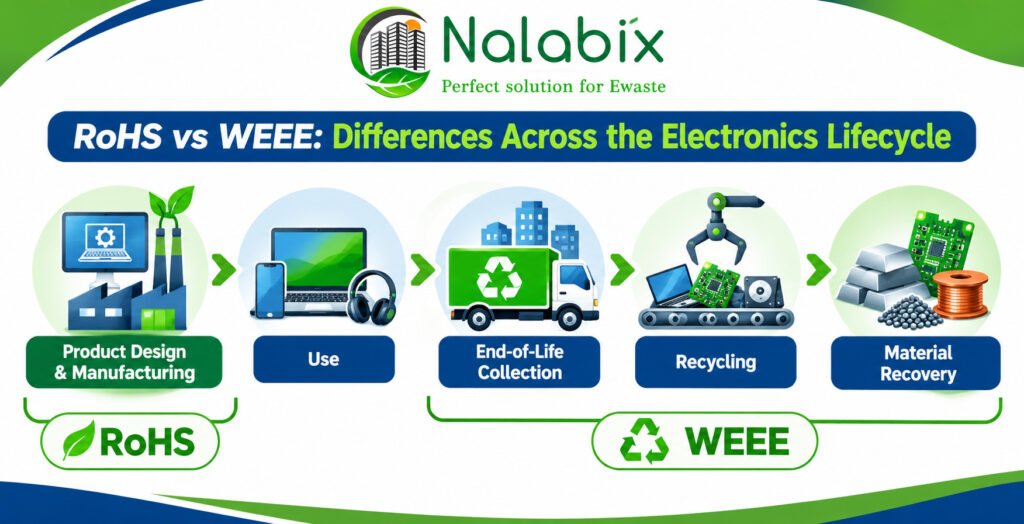
In simple terms, RoHS limits certain hazardous substances used in electronics, while WEEE establishes requirements for collecting, treating, recovering, and recycling electrical and electronic equipment when it becomes waste.
What Is the RoHS Directive?
The Restriction of Hazardous Substances (RoHS) Directive 2011/65/EU is an EU regulation designed to reduce hazardous substances in electrical and electronic equipment placed on the European market.
It primarily influences the design, material selection, and manufacturing stages of an electronic product.
RoHS currently restricts ten substances, including:
- Lead, mercury, cadmium, and hexavalent chromium.
- Two groups of brominated flame retardants: PBB and PBDE.
- Four phthalates: DEHP, BBP, DBP, and DIBP.
These substances are restricted because of their potential risks to human health and the environment. The restrictions have specific concentration limits and exemptions, rather than representing an absolute ban in every application.
For manufacturers, RoHS compliance means assessing materials and components, maintaining appropriate technical documentation, and demonstrating that applicable substance restrictions are met.
Reducing hazardous substances at the manufacturing stage can also make electronics safer to handle and easier to manage when they eventually become waste.
reference: European Commission – RoHS Directive
What Is the WEEE Directive?
The Waste Electrical and Electronic Equipment (WEEE) Directive 2012/19/EU focuses on preventing and managing waste from electrical and electronic products.
Its primary concern is what happens to electronics when they are no longer needed or reach the end of their useful life.
The directive supports:
- Separate collection of discarded electronics.
- Appropriate treatment and removal of hazardous components.
- Preparation for reuse, recycling, and material recovery.
- Producer responsibility for financing and organizing waste management.
- Collection, recovery, and recycling targets.
WEEE covers many types of electrical and electronic equipment, including computers, televisions, refrigerators, printers, and certain medical devices.
Rather than allowing discarded electronics to enter ordinary waste streams, WEEE encourages systems that recover valuable materials while managing hazardous components responsibly.
For a broader understanding, explore what is considered electronic waste.
reference: European Commission – WEEE Directive
RoHS vs WEEE: What Is the Main Difference?
Both directives protect human health and the environment, but their main responsibilities occur at different points in the electronics lifecycle.
| Category | RoHS Directive | WEEE Directive |
|---|---|---|
| Main focus | Hazardous substances in electronics | Management of discarded electronics |
| Lifecycle emphasis | Design and manufacturing | End-of-life and waste management |
| Primary objective | Reduce restricted hazardous substances | Improve collection, treatment, and recovery |
| Key responsibilities | Product conformity and substance control | Collection, recycling, producer responsibility, and reporting |
| Environmental benefit | Reduces hazardous material content | Reduces improper disposal and encourages resource recovery |
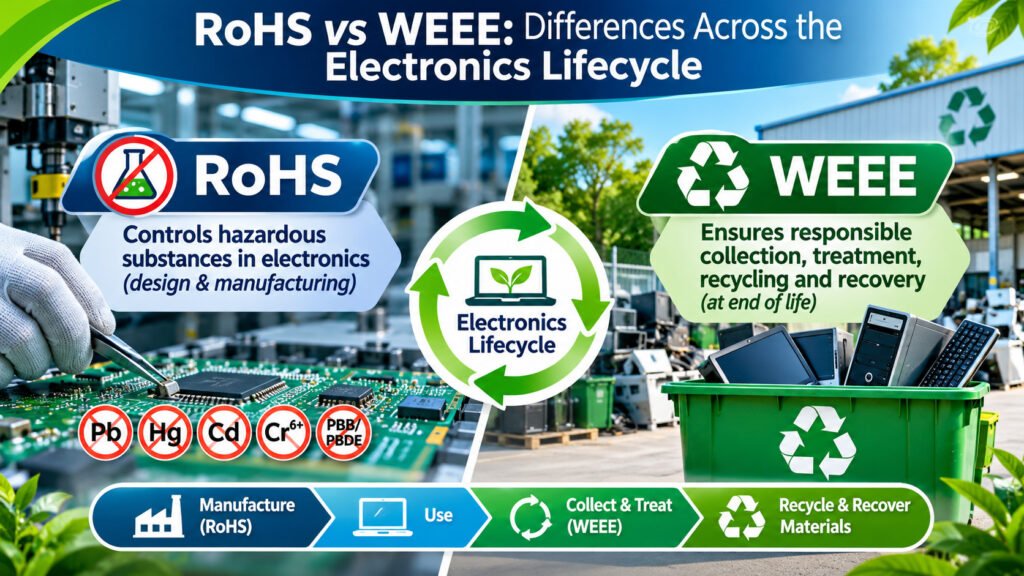
The key distinction: RoHS addresses what goes into electronic products, while WEEE addresses how those products are managed once they become waste.
However, these responsibilities overlap. RoHS also benefits recycling, and WEEE encourages waste prevention and product designs that support reuse and recovery.
How Do RoHS and WEEE Work Together?
Consider the lifecycle of a laptop.
1. Manufacturing: The manufacturer selects components and materials that meet applicable RoHS restrictions, reducing the presence of specified hazardous substances.
2. Distribution and use: The laptop enters the market and is used by its owner. Manufacturers and other responsible businesses must also meet applicable product and WEEE obligations.
3. End-of-life collection: When the laptop is discarded, WEEE requirements help ensure it enters an appropriate separate collection system rather than general waste.
4. Treatment and recycling: The collected laptop can undergo assessment for reuse, removal of hazardous components, dismantling, and recovery of valuable materials.
This approach connects safer product manufacturing with responsible end-of-life management, supporting a more circular electronics economy.
Learn more about how electronic waste is collected and recycled.
Why Do RoHS and WEEE Matter Beyond Europe?
RoHS and WEEE are European Union directives, but their underlying principles are relevant worldwide.
Electronics are manufactured, traded, used, and discarded across international borders. A device manufactured in Asia may be sold in Europe, used for several years, and eventually enter a recycling system in another region.
Businesses exporting covered electronics to the EU must consider applicable RoHS requirements, while producers placing equipment on EU markets may face WEEE registration, reporting, and financing obligations.
Outside the EU, countries may have their own hazardous-substance restrictions, extended producer responsibility systems, and electronic waste regulations. These are not necessarily identical to EU requirements.
For recycling businesses and organizations managing obsolete equipment, understanding both directives encourages better environmental planning, safer handling, and responsible material recovery.
Related reading: WEEE and e-waste trends across Africa.
Frequently Asked Questions About RoHS and WEEE
Is RoHS the same as WEEE?
No. RoHS restricts certain hazardous substances in electrical and electronic equipment, while WEEE regulates the collection and management of electronic waste. They are complementary EU directives.
Does RoHS compliance mean an electronic product is recyclable?
Not necessarily. RoHS compliance means the product meets applicable hazardous-substance restrictions. Actual recyclability depends on its design, materials, available recycling technologies, and treatment infrastructure.
Do RoHS and WEEE apply outside the European Union?
The EU directives apply within their legal scope, but they can affect businesses worldwide that place products on EU markets. Other countries have separate requirements that must be checked individually.
Who is responsible for complying with RoHS and WEEE?
RoHS primarily places product-conformity obligations on manufacturers, with additional responsibilities for importers and distributors. WEEE involves producers, distributors, collection systems, and treatment operators, with specific obligations depending on national implementation.
key Takeaway
RoHS and WEEE approach electronics sustainability from two connected directions.
RoHS reduces hazardous substances at the product-design and manufacturing stages, while WEEE promotes responsible collection, treatment, reuse, and recycling when electronics become waste.
Together, they demonstrate why sustainable electronics management should consider the entire product lifecycle, not simply the point of disposal.
At Nalabix Eco, we support responsible electronic waste management through collection, recycling, IT asset disposal, and secure data destruction, helping organizations manage obsolete equipment responsibly.
For more information, explore our e-waste recycling and IT asset disposal services.