
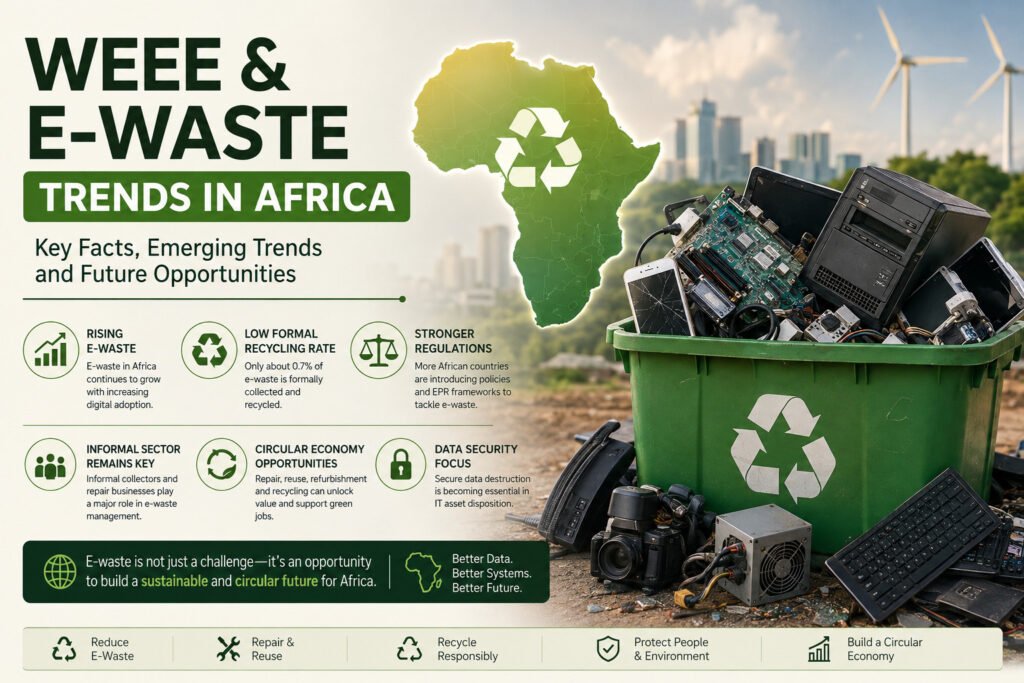
Africa is becoming increasingly connected to the digital economy. Smartphones, computers, televisions, appliances, networking equipment, solar technologies and other electrical products are becoming more common across homes, businesses and institutions.
However, the growth in electronic equipment also creates a growing waste challenge.
WEEE (Waste Electrical and Electronic Equipment), commonly referred to as e-waste, includes electrical and electronic products that have reached the end of their useful life or are no longer wanted. As technology adoption increases, the volume of discarded electronics is also rising.
According to the Global E-waste Monitor 2024, Africa generated approximately 3.5 million tonnes of e-waste in 2022, equivalent to about 2.5 kg per person. Yet only about 0.7% was formally documented as collected and recycled.
These figures highlight both the scale of the challenge and the significant opportunity to improve e-waste management across the continent.
1. E-Waste Generation Is Increasing
One of the biggest trends is the continued growth in electronic consumption.
Digitalisation, urbanisation, population growth and greater access to consumer electronics are increasing the number of electrical and electronic products in circulation.
Africa’s total e-waste generation reached approximately 3.5 million tonnes in 2022, compared with lower volumes in previous years. Globally, e-waste generation reached 62 million tonnes in 2022 and is projected to reach 82 million tonnes by 2030.
The trend means governments, businesses and consumers will need better systems for collecting, repairing, refurbishing and recycling electronics.
2. Formal Recycling Remains Very Low
Perhaps the most important African e-waste trend is the gap between the amount of e-waste generated and the amount formally recycled.
The Global E-waste Monitor estimates that only 0.7% of Africa’s e-waste was formally collected and recycled in 2022. This compares with a global formal collection and recycling rate of 22.3%.
This does not mean that no electronics are being recovered or reused. Electronics can move through informal collection, repair, resale and material recovery channels that are not fully captured in official statistics.
Nevertheless, the low documented rate shows the need for stronger formal collection networks, recycling infrastructure, reporting systems and environmentally sound processing.
3. Informal E-Waste Recycling Remains Important
Across many African countries, informal businesses and individuals play a significant role in collecting, repairing, dismantling and recovering materials from discarded electronics.
This activity can help recover valuable materials and extend the useful life of equipment. However, informal processing may involve unsafe dismantling, uncontrolled burning or inadequate handling of hazardous components.
The challenge is therefore not simply to eliminate informal activity, but to create systems that can connect informal collectors and repair businesses with safer, regulated recycling networks.
A stronger formal-informal sector relationship can help improve collection while protecting workers, communities and the environment.
4. E-Waste Regulations Are Expanding
Another important trend is the development of national policies, legislation and Extended Producer Responsibility (EPR) systems.
The Global E-waste Monitor 2024 identified 11 African countries with a national e-waste policy, legislation or regulation in 2022. Nine used the EPR principle, while only one had a collection target and none had a national recycling target at that time.
EPR can make manufacturers, importers and other producers more responsible for the environmental impacts associated with products throughout their life cycle.
As African countries strengthen these frameworks, businesses are likely to face greater expectations around responsible electronics management, documentation and end-of-life handling.
5. Electronics Are Becoming More Diverse
E-waste is no longer limited to old computers and televisions.
Modern WEEE streams can include:
- Smartphones and tablets
- Computers and laptops
- Servers and networking equipment
- Printers and photocopiers
- Televisions and monitors
- Refrigerators and other appliances
- Batteries and battery-powered devices
- Solar and renewable-energy equipment
- Cables and electrical accessories
- Industrial and medical electronic equipment
The growth of digital infrastructure and renewable-energy technologies is likely to create new categories of electronic waste that require specialised collection and recycling systems.
For example, the Global E-waste Monitor projects that retired photovoltaic panels will reach 2.4 million tonnes annually by 2030, compared with about 600,000 tonnes in 2022.
6. E-Waste Is Becoming an Urban Mining Opportunity
Electronic waste is not only a waste-management problem. It is also a source of valuable secondary raw materials.
E-waste contains materials such as copper, aluminium, iron, plastics and precious metals that can potentially be recovered and returned to productive use.
Globally, the metals contained in e-waste generated in 2022 were estimated to be worth around US$91 billion.
For Africa, improving formal recycling could therefore support a more circular economy by keeping valuable materials in circulation while reducing dependence on virgin resource extraction.
This concept is often described as urban mining.
7. Data Security Is Becoming Part of E-Waste Management
As organisations replace computers, servers, hard drives, smartphones and other data-bearing equipment, e-waste management increasingly overlaps with information security.
Simply throwing away an old device does not necessarily remove the information stored on it.
Businesses are therefore paying greater attention to:
- Secure data wiping
- Media sanitisation
- Physical destruction
- Chain-of-custody documentation
- Certificates of data destruction
- Responsible recycling after data destruction
This is particularly important for organisations handling confidential customer, employee, financial or business information.
Responsible IT asset disposition can therefore combine data security, asset management and environmental responsibility.
8. Collection Infrastructure Is a Major Opportunity
A major barrier to better e-waste recycling is not necessarily the absence of recyclable materials. It is often the difficulty of getting discarded electronics into appropriate collection and recycling systems.
Effective e-waste management requires convenient collection points, transport networks, aggregation systems and reliable recycling facilities.
Businesses can contribute by establishing clear internal procedures for separating unwanted electronics from ordinary waste and using responsible recycling providers.
For consumers, convenient collection points can make responsible disposal much easier.
9. Businesses Will Have a Bigger Role
Businesses are among the major generators of IT and electronic waste.
Office computers, monitors, printers, networking equipment, servers, UPS systems and other devices eventually require replacement or disposal.
As sustainability, environmental compliance and information security become more important, organisations are increasingly expected to demonstrate what happens to their retired equipment.
This is creating demand for structured services such as:
Collection → Data Destruction → Sorting → Refurbishment/Reuse → Recycling → Reporting and Certification
A documented process can help organisations manage both environmental and information-security risks.
10. The Circular Economy Will Shape the Future
The future of e-waste management is unlikely to depend on recycling alone.
A circular approach focuses on keeping products and materials useful for as long as possible through:
Repair → Reuse → Refurbishment → Remanufacturing → Recycling
This can reduce the need for new raw materials and extend the useful life of electronic products.
For Africa, expanding repair and refurbishment markets could be particularly valuable because functional equipment can be kept in use rather than immediately entering the waste stream.
What These Trends Mean for Africa
Africa’s e-waste challenge is also an opportunity.
The continent has the potential to develop stronger recycling industries, create green jobs, recover valuable materials, improve resource efficiency and build more circular electronics markets.
However, achieving this requires cooperation between governments, manufacturers, importers, businesses, recyclers, consumers and informal-sector workers.
The most important priorities include:
- Expanding formal e-waste collection networks.
- Strengthening and enforcing e-waste regulations.
- Developing effective EPR systems.
- Improving recycling and recovery infrastructure.
- Supporting safer informal-sector practices.
- Promoting repair, reuse and refurbishment.
- Improving e-waste data and reporting.
- Protecting sensitive data during IT equipment disposal.
- Increasing public awareness about responsible disposal.
- Investing in circular-economy solutions for electronics.
Frequently Asked Questions
Is e-waste a growing problem in Africa?
Yes. Increasing access to electronic products, digitalisation, urbanisation and population growth are contributing to rising e-waste generation.
How much e-waste does Africa generate?
Africa generated approximately 3.5 million tonnes of e-waste in 2022, according to the Global E-waste Monitor 2024.
What percentage of African e-waste is formally recycled?
The Global E-waste Monitor 2024 estimates that approximately 0.7% of Africa’s e-waste was formally documented as collected and recycled in 2022.
What is the biggest opportunity in African e-waste management?
One of the biggest opportunities is building stronger collection and recycling systems while expanding repair, refurbishment, reuse and material recovery.
Is WEEE the same as e-waste?
The terms are closely related and are often used interchangeably. WEEE specifically refers to waste electrical and electronic equipment, while e-waste is the commonly used broader term for discarded electrical and electronic products.
Conclusion
The e-waste landscape in Africa is changing rapidly.
Electronic products are becoming increasingly important to everyday life, businesses and economic development, but their end-of-life management has not yet grown at the same pace.
The low documented formal recycling rate demonstrates the scale of the challenge. At the same time, the growing volume of electronics creates opportunities for recycling, refurbishment, urban mining, green jobs and circular-economy development.
The future of WEEE management in Africa will depend on moving beyond simply disposing of unwanted electronics toward a system that prioritises responsible collection, secure data handling, reuse, recovery and environmentally sound recycling.
For businesses and consumers alike, the message is simple: the end of an electronic product’s useful life should be the beginning of responsible resource recovery—not the end of its story.
Sources
This article is based primarily on data from the Global E-waste Monitor 2024, produced by UNITAR and the International Telecommunication Union (ITU), which remains one of the principal international sources for comparable e-waste statistics.