Every year, millions of computers, mobile phones, televisions, household appliances, and other electrical products reach the end of their useful lives. What happens to these products after they are discarded can have significant consequences for the environment, human health, and resource conservation.
To address this challenge, the European Union introduced the Waste Electrical and Electronic Equipment (WEEE) Directive, a legal framework designed to improve how discarded electrical and electronic equipment is collected, treated, recycled, and recovered.
But what exactly does the WEEE Directive require, and who needs to understand it?
What Is the WEEE Directive?
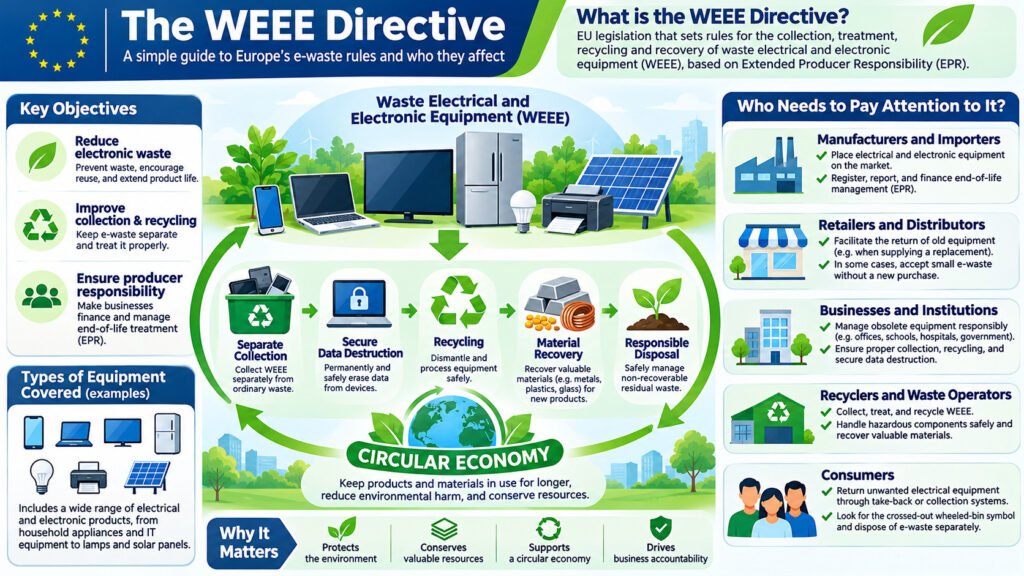
The WEEE Directive (Directive 2012/19/EU) is European Union legislation that establishes rules for managing waste electrical and electronic equipment.
Its primary goal is to reduce the environmental and health impacts of electronic waste while encouraging the recovery and reuse of valuable materials.
The Directive focuses on three important objectives:
- Reducing electronic waste: Encouraging waste prevention, reuse, and responsible product management.
- Improving collection and recycling: Keeping discarded electrical equipment separate from ordinary waste and ensuring appropriate treatment.
- Promoting producer responsibility: Making businesses that place electrical and electronic products on the market responsible for contributing to their end-of-life management.
The current WEEE Directive entered into force in August 2012, replacing an earlier framework introduced in 2003.
Official legislation: EU WEEE Directive 2012/19/EU — EUR-Lex
What Types of Equipment Does the WEEE Directive Cover?
The Directive covers a broad range of electrical and electronic equipment, subject to specific exclusions.
Since August 2018, the EU has used six main WEEE categories.
| Category | Common examples |
|---|---|
| Temperature exchange equipment | Refrigerators, freezers, air conditioners |
| Screens and monitors | Televisions, computer monitors, laptops |
| Lamps | LED lamps, fluorescent lamps |
| Large equipment | Washing machines, large printers, solar panels |
| Small equipment | Electric kettles, toasters, small electrical tools |
| Small IT and telecommunications equipment | Mobile phones, routers, small printers |
The precise classification depends on the equipment’s characteristics, dimensions, and applicable exclusions.
For a more detailed explanation, read our guide on What Items Are Considered WEEE?
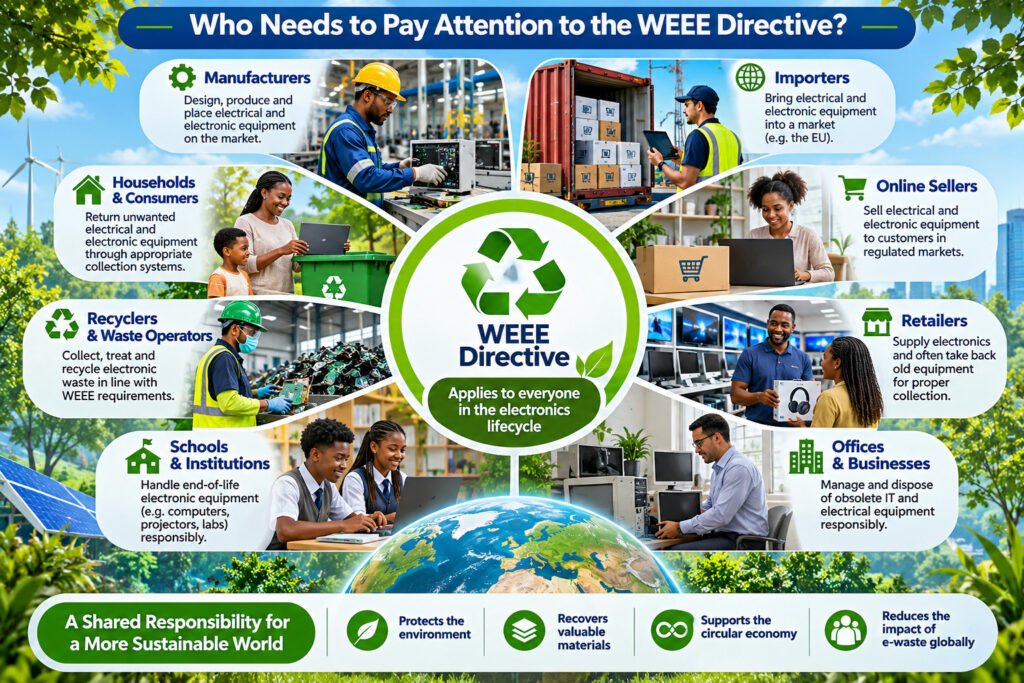
Who Needs to Pay Attention to the WEEE Directive?
Although the Directive originated in Europe, its requirements are particularly important to businesses participating in the EU electronics market.
1. Manufacturers and Electronics Producers
Companies manufacturing electrical and electronic products for EU markets may have legal responsibilities under the WEEE framework.
Depending on their activities and the country concerned, their obligations can include registering with national authorities, reporting equipment placed on the market, and financing appropriate collection and recycling systems.
This approach is known as Extended Producer Responsibility (EPR).
EPR extends a producer’s responsibilities beyond the sale of a product to include aspects of its end-of-life management.
2. Importers and International Suppliers
Businesses importing electrical and electronic equipment into EU countries can also qualify as producers under the Directive.
This is particularly relevant to companies supplying electronics from Africa, Asia, the Americas, or other markets to European customers.
A company does not necessarily need to manufacture equipment inside the EU to have WEEE obligations. Certain overseas online sellers supplying EU customers directly can also fall within the framework.
Businesses should therefore determine which country’s registration and reporting requirements apply before placing products on that market.
3. Retailers and Distributors
Electronics retailers have an important role in collecting unwanted equipment.
Under EU WEEE rules, distributors generally must facilitate the free return of equivalent old equipment when supplying a replacement product, subject to national implementation.
Certain larger electronics retailers must also accept very small WEEE without requiring customers to purchase another product, unless permitted alternative collection arrangements apply.
These requirements help make electronic waste collection more convenient for consumers.
4. Businesses, Institutions, and Organizations
Offices, schools, hospitals, banks, government institutions, factories, and technology companies regularly replace electronic equipment.
While simply owning or discarding equipment does not automatically make an organization a WEEE producer, organizations still need to follow applicable national waste-management requirements.
Responsible practices include identifying obsolete equipment, arranging appropriate collection, documenting disposal, and protecting confidential data before releasing storage devices.
For organizations disposing of computers, servers, hard drives, and other data-bearing equipment, secure data destruction is an important additional consideration.
Data protection requirements are separate from the WEEE Directive, even though they often arise during the same disposal process.
5. E-Waste Collectors and Recycling Companies
Waste collectors, treatment facilities, and recycling operators are essential to implementing the Directive.
They help ensure that discarded electronics are collected separately, hazardous components are handled appropriately, and recoverable materials are processed responsibly.
Operators working within EU-regulated WEEE systems must follow applicable treatment, permitting, recordkeeping, and environmental requirements.
Learn more about the science behind electronics recycling.
6. Consumers and Households
Consumers are also part of the solution.
When a phone, refrigerator, television, or another electrical product is no longer needed, it should be directed to an appropriate collection or take-back system instead of being mixed with ordinary household waste.
The crossed-out wheeled-bin symbol commonly found on electrical products indicates that the equipment requires separate collection.
What Are the Main Requirements of the WEEE Directive?
The framework establishes several important responsibilities.
Separate collection: Electronic waste should be collected separately from unsorted municipal waste.
Producer registration and reporting: Businesses classified as producers generally need to register and report relevant equipment placed on individual national markets.
Financing end-of-life management: Producers are required to contribute to the collection, treatment, recovery, and environmentally sound disposal of covered equipment.
Proper treatment and recovery: Collected equipment must undergo appropriate treatment, including the management of hazardous components and recovery of useful materials.
Consumer information: Consumers must be informed about separate collection systems and the environmental importance of responsible disposal.
The Directive also establishes national collection targets. Under its general framework, EU Member States have been required since 2019 to achieve a collection rate of 65% of the average weight of electrical and electronic equipment placed on the market during the preceding three years, or alternatively 85% of WEEE generated.
These are Member State collection targets, not automatic recycling quotas imposed individually on every business.
For additional guidance, see the European Commission’s WEEE Responsibilities for Manufacturers and Producers.
Does the WEEE Directive Apply Outside Europe?
The EU WEEE Directive is not a worldwide law. Its legal requirements operate through the EU framework and national implementing legislation.
However, businesses outside Europe may still need to comply when their commercial activities bring them within EU WEEE rules, particularly when placing electrical and electronic equipment on EU markets.
Other countries have their own electronic waste legislation, collection systems, and producer-responsibility arrangements.
For example, African countries are developing and strengthening electronic waste policies as technology consumption and electronic waste generation increase.
The underlying principles—waste prevention, producer responsibility, safe treatment, and material recovery—have relevance well beyond Europe.
Explore our related article on WEEE and E-Waste Trends in Africa.
Why Is the WEEE Directive Important?
The Directive addresses several connected challenges.
Environmental protection: Improperly managed electronic waste can release hazardous substances and contribute to contamination of soil, water, and air.
Resource conservation: Electrical equipment contains materials such as copper, aluminium, steel, and precious metals that can potentially be recovered and reused.
Circular economy development: Better collection, repair, reuse, and recycling help keep products and materials in productive use for longer.
Business accountability: Producer registration, reporting, and organized waste-management systems make end-of-life responsibilities more visible.
These benefits explain why responsible electronic waste management has become an important subject for governments, industries, businesses, and communities worldwide.
How Can Businesses Prepare for WEEE Requirements?
Organizations involved in electrical and electronic equipment should begin by understanding their role in the product lifecycle.
- Identify the equipment: Determine which products fall within relevant electrical and electronic equipment categories.
- Check applicable laws: Establish whether the business is considered a producer, importer, distributor, waste holder, or recycling operator in each market.
- Review registration obligations: Confirm applicable national WEEE registration, reporting, and financing requirements.
- Arrange appropriate end-of-life management: Use suitable collection, treatment, and recycling systems, with secure data handling where necessary.
- Maintain documentation: Keep relevant records of equipment, collections, transfers, treatment, and recycling activities.
These measures help businesses establish a more transparent and accountable approach to electronic waste management.
For support with responsible electronics collection, IT asset disposal, and data destruction in Kenya, explore Nalabix Eco’s services.
Frequently Asked Questions About the WEEE Directive
What does WEEE stand for?
WEEE stands for Waste Electrical and Electronic Equipment. It describes discarded electrical and electronic products and, in the EU legal definition, includes their components and consumables present when discarded.
Is the WEEE Directive mandatory?
Yes. EU Member States implement the Directive through national legislation, and relevant businesses must comply with the requirements applicable to their activities and markets.
Does the WEEE Directive apply to small businesses?
Yes, it can. The size of a business does not automatically exempt it from WEEE requirements. Its activities, products, and the applicable national rules determine its obligations.
Who pays for WEEE recycling?
Under the EU’s Extended Producer Responsibility framework, producers generally finance relevant collection, treatment, recovery, and disposal obligations. The precise arrangements depend on the equipment, when it was placed on the market, and national legislation.
Is the WEEE Directive the same as the RoHS Directive?
No. The WEEE Directive addresses electrical and electronic equipment at the waste-management stage. The RoHS Directive restricts certain hazardous substances in electrical and electronic equipment placed on the market. The two laws are related but serve different purposes.
Are solar panels covered by WEEE?
Yes. Photovoltaic panels are covered by the EU WEEE framework, with specific provisions governing aspects of their financing and end-of-life management.
What happens if a business does not comply?
Noncompliance may lead to enforcement action or penalties under the relevant country’s national laws. The consequences depend on the jurisdiction and the nature of the violation.
Conclusion
The WEEE Directive is an important part of Europe’s approach to responsible electronic waste management.
It establishes a framework for collecting discarded equipment, recovering valuable materials, reducing environmental harm, and ensuring that relevant producers contribute to managing products at the end of their lives.
Manufacturers, importers, online sellers, distributors, recycling operators, institutions, and consumers all have reasons to understand how the system works, although their legal responsibilities differ.
For businesses operating internationally, the central lesson is simple: understand the waste-management laws that apply in each market and plan for responsible electronic equipment disposal from the beginning.
At Nalabix Eco, we promote responsible electronic waste collection, recycling, and secure data destruction as part of building a cleaner and more sustainable future.